A few years ago my sister-in-law and I went on a trip, when we returned, she mentioned how she missed her kids' fingers and toes. Although I had noticed my own children's and knew them to be important in growth and development, I had not stopped to think of how I missed them. I realized that in fact, this was the part of my children that I touched, soothed, held, and held me back. This was our means of communication from birth. Fingers and toes are parts of hands and feet. These of my own children were beyond precious to me.
When my children are sleeping, I often hold their hands, or stroke their feet. I place those hands upon my own cheek as they once reached to touch as infants. The feeling of their palms on my skin makes my heart beat faster, or skip a beat. The tiny pulses of love that emanate between us are hidden and unspoken.
As a Montessori teacher, I am aware of the importance in the developmental process that the hand signifies. We look for strength, dexterity, grip, etc to see the grown and development of a child. We see feet as a path to independence, and know the value of stability for motor coordination, and overall balance and function. Curiosity and wonder are fulfilled by hands and feet. Touch and sensation map the brain in comprehension and understanding of the world. And I'm sure anthropologists, poets, writers, artists, and musicians have all filled us with the poetic beauty that hands provide and create for our species.
However, it is as a parent that I understand the love that is shared between me and my child. Their hands and feet, their love and instability, their trust, desire, and will lay between those 10 fingers and 10 toes. It is also a sadness that draws me to them in silence as I watch them become more independent, trusting their own steadiness to walk away, or ability and will to let me know they can do it on their own. As they grow in confidence of their own hands and feet discovering the world, I sense the distance that could grow between us. And holding on to them just a little longer in my own hands gives me paramount strength to let them go, to be free, to do on their own, and to love them more deeply than the day before.
Showing posts with label montessori. Show all posts
Sunday, August 16, 2015
Thursday, March 13, 2014
The Montessori Child at School and Home (3-6)
I tried to recap my discussion with parents into their ages, work at school and things they can do at home and things parents can do with their children. This is really brief and a bit all over, but I hope it can help.
Breakdown of the Primary 3 year cycle in development, abilities, and capabilities.
1st year: (2.5- 4 years)
- Allow them to do more at home: chores, getting dressed, helping out, cooking, cleaning,
- Read with them and read at higher levels
- Don't interrupt focus and concentration
- Help them develop confidence- key to focus, concentration, and good work habits
- Children are able to play alone at home and give parents time to work and do adult chores. They need to become aware of patience.
- They are being exposed to the sounds, and possibly the 1-10 quantities and symbols
- As they are closer to 4 they will be introduced to larger quantities and the decimal system possibly with addition
- Depending on the child they will be exposed to the sounds and the cursive letters that correspond. We introduce writing before reading in Montessori.
- We help them refine their large and fine motor skills especially their dexterity in the fingers and wrist- it's a preparation for writing. (At home: work with flour to make dough, very different skill than play-dough).
- We also help them inhibit their movements by teaching them control and coordination. This helps them with self control.
- They are internalizing their work, don't push
- May not be as focused at school, but they are learning from the others
- Quantities, number symbols, large quantities, addition, and possibly subtraction will be introduced (depending on the child).
- There is a lot of repetition, this helps "incarnate" their knowledge. The repetition and the material gives them a firm grasp of the concepts so that once the next lesson is given, they are ready.
- They will be working with the golden beads for a long time, maps, and other sensorial/ exploration work.
- The moveable alphabet and beginning of writing is introduced along with phonograms (2 sounds creating a third "ch")
- many are straddling the younger years with the readiness for maturity
- Allow for independence
- Introduce them to the concept of consequences and follow through
- Implement chores, rules, and agreed upon consequences before incidents occur
- Read with them and help them recognize their sounds and numbers (when presented)
- Help them become patient and understanding by not giving into them or turning to them when they demand your attention
- Start game nights, family outings, family dinners and cooking
3rd year: (mostly ages 5+)
- Be consistent on your "rules"
- Invite children to come up with family chores, rules, grocery lists, and also their own consequences
- Begin to enforce patience by setting timers, or giving timelines. Reinforce them and make sure they know it or understand it before walking away.
- Needs vs. privileges: help them understand basic needs and what they are privileged with in their lives.
- Consequences can be certain privileges being taken away- they must know this before. Do not react, but enforce prior discussions.
- Limit media to weekends and even then to an hour or less
- Read higher levels, chapter books and help them build vocabulary
- Read and then ask questions about content.
- Parents can take turns spending time with individual children and ask them what they'd like to do, spend time to get to know your child
- This is the year of leadership in the environment, they blossom and it's sudden. Once they are on a path of abstraction (less materials), they move quickly.
- Children are ready for larger questions to be answered, very curious, very scientific, showing readiness for cosmic education/ Elementary
- Children will be exposed to addition, subtraction, multiplication, and division.
Regarding
media: I strongly urge you all to put it away and allow it on
occasion. It is EXTREMELY evident who watches TV and also when they
watch it in the morning. It is a huge distraction in their mind and
their focus and concentration on the materials are lost. If media is not good for a developed adult brain, think of what damage it is causing the young developing brain.
Chores, refining fine motor skills, helping out at home.
Experiencing nature, and playing on their own, time to think and be creative
Writing before reading. Children write with the moveable alphabet
100 board. Children practice the sequence of 1-100 and explore by learning patterns in numbers.
Helping prepare a classroom meal by peeling garlic. Refining fine motor skills and contributing to the community.
Controlling their impulses by observing a friend with hands behind their back.
Associating quantities of the decimal system with their symbols
Working with flour and dough at home for refining fine motor skills and helping with chores.
Counting 1-10 and associating a quantity with it.
A very young 3 year old refining his motor skills with nuts and bolts.
Labels:
at home,
chores,
discipline,
freedom,
mathematics,
media,
montessori,
responsibility,
writing and reading
Sunday, November 17, 2013
Handwriting: The importance of repetition and perfection.
A few months ago I wrote a post about cursive and the art of handwriting. I had not yet re-entered the classroom when I wrote it. Now that I've been there for almost 3 months, it is something I see as essential. My experience thus far is difficult to write in a short post, but what I will say is how it has made me love and appreciate the Montessori materials and philosophy even more.
From my experience before and now, and even seeing my own child's development in language and handwriting there are somethings I have come to realize. I will try to summerize.
Today language is viewed as reading. It's more important to read than write. Whereas in Montessori, we teach children to write before they read (another post I wrote). I see that reading is vial in most traditional education since children need to read and comprehend for test taking so they can color in a bubble. Not to simplify this issue, but it has come down to test taking and finding that right answer, so reading and reading comprehension is valued over writing abilities.
The results are valued rather than the process. Not so in Montessori. In our classrooms you have all the time in the day/week/month to work through the task. There is no rush. We invite the children to take their time, take care and pride in their work, take the time in between to work on something else, and work on things at their pace and pleasure. It is not a task to be crossed off a list or be weighed down by. It is the process of doing, and re-doing (repetition) that builds the synaptic network. A young child is joyous when doing a task that is of interest to them. This is part of what we call "following the child". We are guided as teachers by their interest and so we provide them the opportunity to further their interest in that field.
Bringing home "work" and homework. Often we find ourselves telling parents not to give children workbooks and apps that "help" children learn at home. This is mostly because when a child is doing all this work at home, coming to school where they have freedom to choose their work and friends gives them the opportunity to also choose to socialize instead of choosing work. Mostly because they are already exhausted from working at home. Every child needs a break from work. This is why you will see a child working for hours with the moveable alphabet or the addition strip board and after they put it away, they are calm and collected and choose "lighter" work where they color or do some sewing, or just sit and watch others work. They need that time to process what they have done.
So, why do Montessori children not bring loads and load of paperwork? Two reasons; 1. Dr. Montessori was an early conservationist. She believed that we do not need to waste. She found that using materials like the sandpaper letter, moveable alphabet, and other hands-on materials allowed a child to work and not have pages and pages to take home. 2. The children perfect their work in the class with the materials, with the chalkboard, they practice their handwriting with the sandpaper letters and various alphabets, then when they are ready, the take out a small piece of paper and transcribe their intentions and ideas onto that paper. As they become more proficient, they can lose the materials and simply move onto paper, but that takes 3 years of being in a classroom.
Handwriting. As I wrote and copied the authors essay in the handwriting post, handwriting is a lost art. Children are comfortable and choose to write in print. They see print around and find it easier to copy. Handwriting is not simply about copying written symbols, but a means of expression. Just as it is individual and personal so should our handwriting be. It is an expression of who we are. The typed/ printed word is static even with the myriad fonts out there. A handwritten note is still valued over a typed email, why? The personal touch. So, why do we not encourage a young child to develop that ability and sensibility?
Is it really worth it and beneficial to teach a child the easy way or the short-cuts? What are the long-term effects when we have adults who are lacking these skills, sensibilities, and executive functions?
One of the key philosophies of Dr. Montessori was “Never give more to the mind than you give to the hand.” And this is why a Montessori classroom looks the way it does!
From my experience before and now, and even seeing my own child's development in language and handwriting there are somethings I have come to realize. I will try to summerize.
Today language is viewed as reading. It's more important to read than write. Whereas in Montessori, we teach children to write before they read (another post I wrote). I see that reading is vial in most traditional education since children need to read and comprehend for test taking so they can color in a bubble. Not to simplify this issue, but it has come down to test taking and finding that right answer, so reading and reading comprehension is valued over writing abilities.
The results are valued rather than the process. Not so in Montessori. In our classrooms you have all the time in the day/week/month to work through the task. There is no rush. We invite the children to take their time, take care and pride in their work, take the time in between to work on something else, and work on things at their pace and pleasure. It is not a task to be crossed off a list or be weighed down by. It is the process of doing, and re-doing (repetition) that builds the synaptic network. A young child is joyous when doing a task that is of interest to them. This is part of what we call "following the child". We are guided as teachers by their interest and so we provide them the opportunity to further their interest in that field.
Bringing home "work" and homework. Often we find ourselves telling parents not to give children workbooks and apps that "help" children learn at home. This is mostly because when a child is doing all this work at home, coming to school where they have freedom to choose their work and friends gives them the opportunity to also choose to socialize instead of choosing work. Mostly because they are already exhausted from working at home. Every child needs a break from work. This is why you will see a child working for hours with the moveable alphabet or the addition strip board and after they put it away, they are calm and collected and choose "lighter" work where they color or do some sewing, or just sit and watch others work. They need that time to process what they have done.
So, why do Montessori children not bring loads and load of paperwork? Two reasons; 1. Dr. Montessori was an early conservationist. She believed that we do not need to waste. She found that using materials like the sandpaper letter, moveable alphabet, and other hands-on materials allowed a child to work and not have pages and pages to take home. 2. The children perfect their work in the class with the materials, with the chalkboard, they practice their handwriting with the sandpaper letters and various alphabets, then when they are ready, the take out a small piece of paper and transcribe their intentions and ideas onto that paper. As they become more proficient, they can lose the materials and simply move onto paper, but that takes 3 years of being in a classroom.
Handwriting. As I wrote and copied the authors essay in the handwriting post, handwriting is a lost art. Children are comfortable and choose to write in print. They see print around and find it easier to copy. Handwriting is not simply about copying written symbols, but a means of expression. Just as it is individual and personal so should our handwriting be. It is an expression of who we are. The typed/ printed word is static even with the myriad fonts out there. A handwritten note is still valued over a typed email, why? The personal touch. So, why do we not encourage a young child to develop that ability and sensibility?
Is it really worth it and beneficial to teach a child the easy way or the short-cuts? What are the long-term effects when we have adults who are lacking these skills, sensibilities, and executive functions?
One of the key philosophies of Dr. Montessori was “Never give more to the mind than you give to the hand.” And this is why a Montessori classroom looks the way it does!
Labels:
cursive,
handwriting,
homework,
montessori,
writing and reading
Saturday, September 7, 2013
"What is Montessori" 3.0- Sense of Order
Order.
When we think of
order, most often the image or idea that comes into mind is things in a
row, things perfectly lined up, clean, neat, tidy, structured, etc.
There is a bit of a confusion when culturally (today) we refer to things
having order. In some ways, it's militant. Children are supposed to
be "orderly". Things are supposed to be in order. We must obey orders,
so on and so forth. However, when Dr. Montessori referred to a child
having sensitive periods and one of the earliest and strongest being
their "sense of order," she did not imply my previous descriptions. From birth to 6 during the absorbent mind the child goes through creative periods or windows of opportunity which are transitory blocks of time in which he is passionately absorbing with one aspect of his environment to the exclusion of others.
These (passions) actions allow him to acquire a certain skill or capacity. The sensitive period has well defined activities guided by an unconscious inner drive towards the environment. The child looks fascinated with what he is doing. It makes the child repeat and repeat with enormous interest so he can establish the function.
Dr. Montessori talked about 4 main sensitive periods: language, order, refinement or movement, and refinement of senses. They are characterized as transitory: they will only remain for a definite and limited time and disappear to never return. They will disappear if the skill has developed or not, and they all run parallel for those initial 6 years. ALL children have and go through these periods.
A child will know, to sweep up a mess the steps are: to get a broom, sweep all items to a pile carefully, place the boom back, get a dustpan and brush, take the brush out, sweep it many times catching the dirt in the pan, emptying the pan into the trash can (the trash can may need to be opened, then closed), then place the brush back on the dustpan, and then return it to it's place.
Orderliness is NOT a sense of order.
In my own two children I have seen their sense of order come and go, I have seen them stronger in one, then at times stronger in the other and both at different ages. My older daughter had a very strong sense or order when she was really young, and at times still does. We had to do the same routine. My husband and I would joke that she would be upset if we did something differently, and we'd have to walk back and repeat the motion in the way in which she knew it should have been done. Now, my second child who is two and a half is exhibiting very similar patterns now. She had other things which she was captivated by in her younger months.
https://vimeo.com/39742817
Tuesday, July 16, 2013
"What is Montessori?" 1.0
I thought I'd share a quick overview of Montessori. My mom and I have been helping my sister with a project, and this is a summery of what my mom emailed her. Since I've been writing similar things in my head and hoping to write up "What is Montessori" I figured I'd break it up into a series. I'm considering having a few friends and colleagues contribute to this endeavor. Hopefully we can cover some questions out there in the next few months.
The Montessori method of teaching was originally used with disadvantaged children. In a Montessori environment each person must be considered as a whole. All aspects of the individual are equally important and inseparable regarding his or her interests and needs. These aspects are:
- Physical: needs are addressed in the environment by having furniture of an appropriate size. For example the chairs /tables shelves, bathroom fittings, sinks, etc are all at child level. In the case of disabled children their needs are accommodated.
- Emotional: The material calls them to work. It is appealing, and self explanatory and brings about a sense of peace and harmony. Montessori referred to this as 'normalization'
- Cognitive: The concepts have already been absorbed wholly in the young child. Materializing these concepts now make it more meaningful. E.g weight, textures, dimensions,sounds to name a few.
- Social: The children are of varied age groups resembling a family and a home-a perfect social environment Older children play the role of models to younger children who like to emulate them. In the 3 year period, every child gets to be a follower before being a leader.
- Spiritual: Children are taught to respect the material. Every piece of material has to be handled appropriately. Misuse is never allowed. They learn to treat people around them the same way.
- Aesthetic: The material is beautiful, clean, fragile and delicate, appealing to to the senses
Shared on: More the Merrier Mondays, Eco-Kids Tuesday, Tuesdays with a Twist, wildcrafting wednesday, Wildlife Wednesday, simple lives thursdays, HomeAcre Hop, small footprint family, Friday Nature Table, fresh eggs daily, Transformation Thursday, Thrifty Home, Fresh Bites Friday, Wednesday Fresh Food, Sunday Parenting Party, hip homeschool moms, No Time for Flash Cards, Living Green Tuesday, Montessori Monday, Farm Girl Blog Fest, Food Renegade, Eat Make Grow, Saturday Show and Tell, Kids in the Kitchen, Learning for Life, Mums Make Lists, It's Playtime, All Year Round Blog Carnival
Tuesday, April 2, 2013
Writing (in cursive) Before Reading.
In a Montessori classroom we say that after a child learns his/her sounds they are introduced to writing before reading. It is usually the opposite from traditional schools. After they have learned their sounds with the sandpaper letters they practice on a chalkboard. Then they are introduced to the moveable alphabet. This is a box that contains cut outs of each letter with consonants in pink and the vowels in blue. AMI training these days encourages cursive handwriting due to the natural circular motion. There are many exercises prior to language that prepares the child and helps them develop their gross and fine motor skills so they are ready.
There is also a lightness in touch where children learn not to press too hard when they write in cursive. Observe a child who writes in print and you will notice that there is a force in which letters are written.
I had purchased a moveable alphabet years ago when I had thought I would be doing a different project. It ended up not working out and so I had it at home. Once my daughter started using it at school and noticed the one I had at home, she wanted to practice at home. I do not make her practice any of her lessons from school at home. The beauty of Montessori is that a child learns at his/her own pace and the classroom provides enough time for them to work at school. This is also why Montessori children never have homework- oh goodness, what a blessing! So, when we did the moveable alphabet at home, she chose to write her own words and write them as she hears them. This is where the "writing before reading" idea comes in. When a child writes, they write what is in their head. They write as they hear the word. We do not discourage them by correcting their spelling. The key is to develop the love and interest for learning and the desire to repeat. Once they practice, then as a gentle guidance, we can help them recognize sounds they miss, or we introduce additional sounds that are created with multiple letters such as "sh, ch, ar, oo, " so and and so forth. Then much later, do you help them with "spelling." This step in learning to write before reading allows them to master the language so that when reading, it is smooth and they already know to recognize the sounds to "put together".
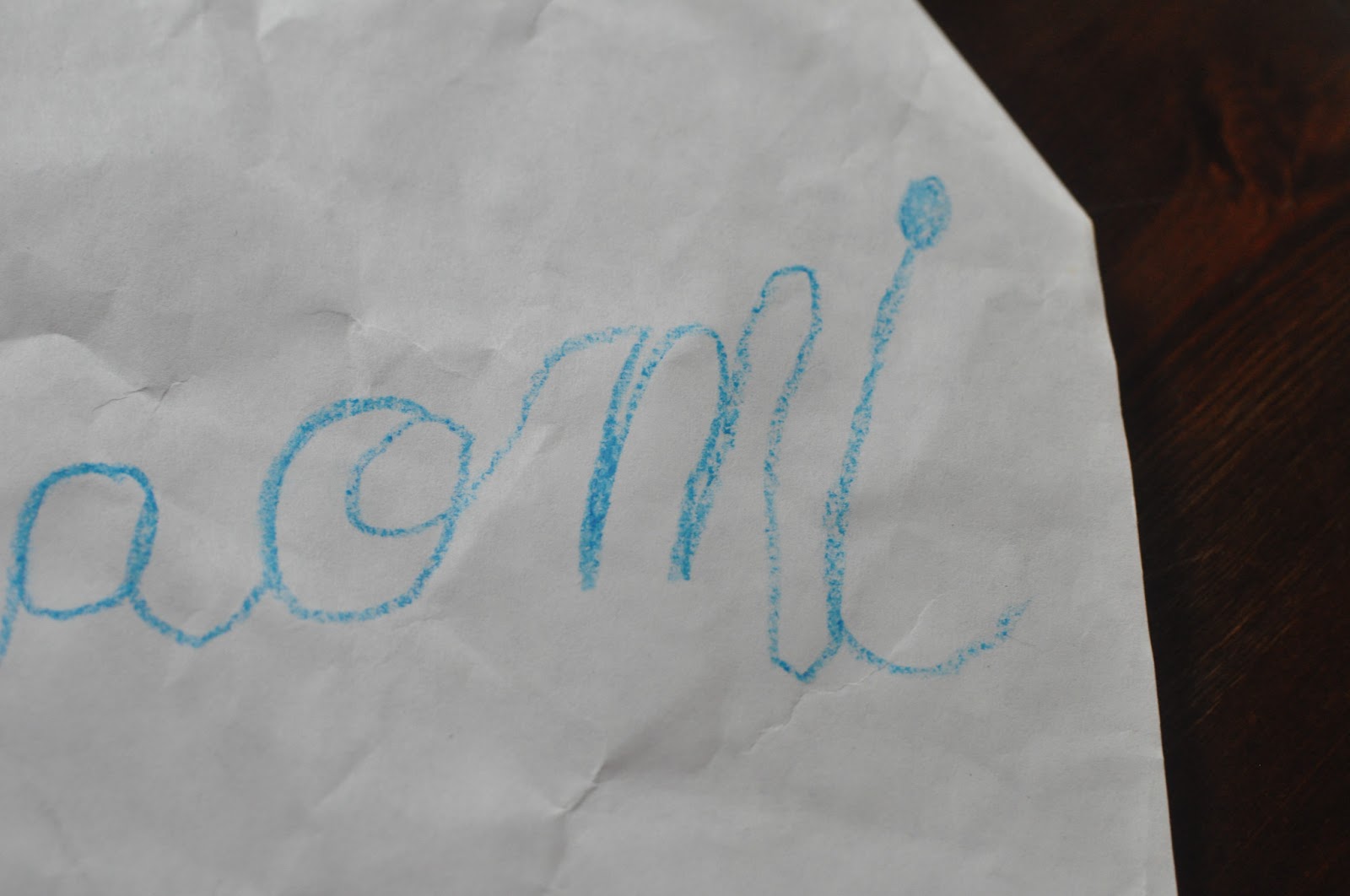
The entire process is just beautiful. I miss seeing it in the classroom and I miss seeing the small steps in which my child must be blossoming in the classroom. It was a total surprise when last week I saw her writing her name in cursive on a piece of paper. It all happened so quickly. She still has trouble recognizing and remembering some letters, but I know that it will click as she continues to repeat and practice writing. In the past 6 months she has been recognizing letters here and there and points them out trying to read. Gradually, we have noticed that she is trying to read whenever she can. Sometimes when we read at home, she wants to read a page or a sentence. I allow her to as much as she can and to the best of her ability. These are times when I also explain that two O's make the sound "oo", or something like that.
It's hard not to be excited and happy for your child when they reach these milestones. There is so much joy in them that it fills your heart with joy and in many ways, pride. I'm not sure why we are proud, but that is the word we often use, and it's silly. What right do we have to be proud of their abilities, but it is the way it is, and it is true. I guess that's part of being a parent vs being a teacher. In my home, I'm my child's parent and not her teacher. This I had to accept early on. I burdened and guilt-ed myself for almost 9 months trying to think of the right way to be when I realized I had to let go of being a "teacher" to my child and just be her mother. This freedom was the best thing as I allowed myself to make mistakes and learn from them. It allowed me to enjoy her and enjoy the process of being a parent. The pressure to be "on top" and be prepared before her is impossible when you are a new parent and a first time parent. In many ways, we are learning as we go. There are lots of things we can be prepared for and we should, but when it comes to our own children and how we respond to them, we learn our threshold and our abilities at the given moment. It's ok to recognize and embrace it. We are human, just as our children are. We too are still learning. Life is far too short for perfection, so enjoying the journey is far more satisfying.
I'm trying to keep some anonymity to my children, but let's pretend you don't know her name and just recognize her handwriting instead :)
Shared on: wildcrafting wednesday, simple lives thursdays, small footprint family, fresh eggs daily, Fresh Bites Friday, Wednesday Fresh Food, Sunday Parenting Party, hip homeschool moms, Living Green Tuesday, Montessori Monday, Food Renegade, Eat Make Grow, Mums Make Lists, Learning for Life,
There is also a lightness in touch where children learn not to press too hard when they write in cursive. Observe a child who writes in print and you will notice that there is a force in which letters are written.
I had purchased a moveable alphabet years ago when I had thought I would be doing a different project. It ended up not working out and so I had it at home. Once my daughter started using it at school and noticed the one I had at home, she wanted to practice at home. I do not make her practice any of her lessons from school at home. The beauty of Montessori is that a child learns at his/her own pace and the classroom provides enough time for them to work at school. This is also why Montessori children never have homework- oh goodness, what a blessing! So, when we did the moveable alphabet at home, she chose to write her own words and write them as she hears them. This is where the "writing before reading" idea comes in. When a child writes, they write what is in their head. They write as they hear the word. We do not discourage them by correcting their spelling. The key is to develop the love and interest for learning and the desire to repeat. Once they practice, then as a gentle guidance, we can help them recognize sounds they miss, or we introduce additional sounds that are created with multiple letters such as "sh, ch, ar, oo, " so and and so forth. Then much later, do you help them with "spelling." This step in learning to write before reading allows them to master the language so that when reading, it is smooth and they already know to recognize the sounds to "put together".
These were taken back in January. I did help her with the "ou" in house.
The last one is steller's jay, a local bird she loves.
The entire process is just beautiful. I miss seeing it in the classroom and I miss seeing the small steps in which my child must be blossoming in the classroom. It was a total surprise when last week I saw her writing her name in cursive on a piece of paper. It all happened so quickly. She still has trouble recognizing and remembering some letters, but I know that it will click as she continues to repeat and practice writing. In the past 6 months she has been recognizing letters here and there and points them out trying to read. Gradually, we have noticed that she is trying to read whenever she can. Sometimes when we read at home, she wants to read a page or a sentence. I allow her to as much as she can and to the best of her ability. These are times when I also explain that two O's make the sound "oo", or something like that.
It's hard not to be excited and happy for your child when they reach these milestones. There is so much joy in them that it fills your heart with joy and in many ways, pride. I'm not sure why we are proud, but that is the word we often use, and it's silly. What right do we have to be proud of their abilities, but it is the way it is, and it is true. I guess that's part of being a parent vs being a teacher. In my home, I'm my child's parent and not her teacher. This I had to accept early on. I burdened and guilt-ed myself for almost 9 months trying to think of the right way to be when I realized I had to let go of being a "teacher" to my child and just be her mother. This freedom was the best thing as I allowed myself to make mistakes and learn from them. It allowed me to enjoy her and enjoy the process of being a parent. The pressure to be "on top" and be prepared before her is impossible when you are a new parent and a first time parent. In many ways, we are learning as we go. There are lots of things we can be prepared for and we should, but when it comes to our own children and how we respond to them, we learn our threshold and our abilities at the given moment. It's ok to recognize and embrace it. We are human, just as our children are. We too are still learning. Life is far too short for perfection, so enjoying the journey is far more satisfying.
These are from yesterday. As you see in the corner, this is a sandpaper letter from my mother tongue. Montessori comes in all languages :)
Notice, how in the previous photos she spelled frog with the "r" and here she did not. Also, this time, we used objects to bring a new interest to the activity. This also allows children to work independently. The last one is supposed to be "okapi," but as we all know there are two letters in the for the "K" sound. Again, a point in how you don't need to correct and it will come naturally later on. Best part, is it has the little one saying "okeeepee" around the house! I'm trying to keep some anonymity to my children, but let's pretend you don't know her name and just recognize her handwriting instead :)
Shared on: wildcrafting wednesday, simple lives thursdays, small footprint family, fresh eggs daily, Fresh Bites Friday, Wednesday Fresh Food, Sunday Parenting Party, hip homeschool moms, Living Green Tuesday, Montessori Monday, Food Renegade, Eat Make Grow, Mums Make Lists, Learning for Life,
Labels:
freedom,
Independence,
lessons,
montessori,
moveable alphabet,
parenting,
writing and reading
Friday, February 8, 2013
Using a utensil- practice activities.
The emphasis for utensils is cultural. Dr. Montessori pointed out that we are a product of our time and place. Where and when we are shape who we are. Forks and spoons are a huge part of the Western etiquette for proper social behavior and table manners. As an adult, it is our responsibility to help our children learn these social norms to adapt into society. Many other cultures, including my own, use their fingers or chopsticks for meals and many different etiquette are part of those cultures and social norms. Because of this, I have allowed my children to both learn to eat with their hands and utensils, we're only now considering introducing the chopsticks to the 4 year old who has shown a great interest in it. I'm working on getting the starter set!
Another aspect of table manners is also washing your hands before and after meals, and sitting while eating. These are often seen as unnecessary or something that will come later as the child grows older. Unfortunately, this is not true. It is far more challenging to change habits when we don't start early. Using wipes to clean an infants hands continues and a child then waits with their hands outstretched for it to be done for them. Instead simply carrying them and washing their hands under running water will be as effective. (I hope to do a pots on Washing Hands soon).
When I was teaching I had a little boy who was almost 3 whose mother asked me if she could come in at lunch time to feed him. I explained that it would be best for him to learn to eat on his own and by being with his peers who varied in age he would adapt quickly. She called me everyday for weeks to see how he was doing. When I said he had a lot of trouble sitting down for the meal she asked me if I would hold him and feed him. I explained this would be impossible and it would be unproductive to his development. It took a long time for this little boy to adapt, mostly because he wasn't expected to do the same at home. He was fed all meals either in a high chair, or dinner which was in front of the TV so he wouldn't walk around as much.
My point in this story, is that it is in the home that the child learns the most basic and vital life skills that will serve him for the rest of his life. Taking a little extra time and effort in the early years will benefit them greatly when they reach adulthood.
I was told a few years ago by a very close friend that she felt ill equipped with carrying on simple things like cleaning and cooking and how to care for herself as an adult because most of her life her mother did everything and never asked that the children help out. (see Road to Independence)
In many ways, we have to let go of things being perfect all the time, or things being messy, or things not being done the way WE want. It's not about us, it's about the child and what's best for their development. The only thing that will be perfect is the joy the child will have when he knows he did something all by himself.
In this "presentation" two similar bowls and a small spoon are set up as above. I spooned all the peas from one bowl to the other very slowly so that she could see my movements. Once I was done, I moved the bowls back from full on left and empty on right, and then moved the tray in front of her so she could carry on.
This is a lesson in the Primary classroom, it's usually for a child between 2 1/2 to 3. My little one is just 2 but I was aware of her abilities and felt confident in giving this to her.
Towards the end, she ended up pouring the grains from bowl to bowl. Depending on who you ask, some might say to stop the activity, but recently when I attended a refresher course, it was also pointed out that if the child is engaged and seems to be concentrating and "working" then we should allow them to go on. If they are misusing by banging and throwing then there is no purpose and it would be wise to ask them to clean up. As you can guess, after a while the peas ended up all over the table and floor and so it resulted in cleaning up.
Shared on :For the Kids Friday, Share it Saturday, hip homeschooling moms, Small Footprint Family

Labels:
Independence,
montessori,
practical life,
table manners,
utensils
Wednesday, December 12, 2012
The Road to Independence
Independence is a word many parents adopt into their vocabulary early on. From the start we all want to help our children become "more independent". Independence, however, is not given or earned, it is a quest of the human condition. Dr. Montessori stated that Independence is psychological and biological. Therefore, as parents and caregivers to these human beings that are newly entering the world, we must respect that need for independence and allow the child to come to his/her full potential.
We do what we can with what we have (financially and with physical space). We didn't have everything we wanted for our first, we accumulated items along the way, and have a wish list that we ask our family to consider for birthdays and holidays.
Here are some ideas on helping your child become more independent based on things that have worked for us:
* Have all items they will need in a low shelf so that they can help set the table, get their bowls, plates, spoons, cups, on their own.
* Use real plates, glasses, cups with handles, forks, etc that are child size so they can feel a part of the family and learn good manners along they way rather than struggling it with it later.
*Keep a routine (vs. a schedule). A routine will help a child know what comes next. Keeping to the same order of things at each meal, cleanup, getting ready for bed, making the bed, getting dressed, etc, will allow them to repeat the same actions over and over thus perfecting that skill.
* Start with small and basic steps. When helping a newly walking child clean up, give them the spoon or fork to take to the kitchen. When they have mastered that, they can then take the cup, and once that is mastered, they can add on carrying the plate, and disposing of the remnants in the trash. (This is a larger topic which I will expand upon in part 2)
* Set up the child's room so that they know where their things are. Keep all clothes in low shelves so they can pick out their clothes and dress themselves. Both my children (very strong willed), loved to pick out their clothes and get dressed by 18 months. It tries my patience frequently at their choices of attire, but in allowing them the freedom to choose and become independent, I must let them make those choices which are also times they can learn a lesson from- like wearing not enough clothing on a cold day.
*Washing hands and blowing noses. Early on, as soon as they start eating, carry your child to the sink and wash their hands. The routine and consistency of washing their hands in water will help them to have control and independence to do it on their own when they start to walk and are able to get to a sink on their own. Think of it as saving the environment from all those wipes.
*Have appropriate size stools or step stools so children can reach up to wash hands, brush teeth, and help out at the counter. Do not put their dishes up high and have them climb up, instead move the dishes lower so they can hold them while having two feet firmly on the ground.
*Give children the opportunity to help in the kitchen to prepare food, set the table, and cleanup all areas of the house. Having child-size brooms, dustpans and such will enable them to be successful.
*One ability must be mastered before being challenged with a new one. Challenges not obstacles was a constant reminder to us when taking the course. When challenged there is a new skill to be learned. When an something becomes an obstacle, we tend to give up or feel inadequate. Mastery of a skill will help the child feel confident so that they can readily acquire new skills.
* We cannot expect children to know what to do just by telling them. We must demonstrate, even if it means letting go of control, and slowing down to a pace that is comprehensible to them.
*Practice a task yourself putting yourself in your child's shoes. This will help you to know how to present the activity to your child. When carrying a glass, use two hands holding it carefully and walking slowly. Children will imitate this behavior and you can encourage them to walk slowly so they can be successful by not dropping it.
Most of all, be patient and slow down. Life is difficult for us as adults, having children adapt to a grownup world is challenging for them, so it's up to us to sometimes change our world to adapt to their needs.
Also check out cooking with kids for ideas in the kitchen and with food prep, and freedom and discipline on the importance of responsibilities which ultimately lead to independence.
Shared on: hiphomeschoolmoms, smallfootprintfamily. Sunday Parenting Party, fresh eggs daily, Kids in the Kitchen, mums make lists,
Living Montessori Now
We do what we can with what we have (financially and with physical space). We didn't have everything we wanted for our first, we accumulated items along the way, and have a wish list that we ask our family to consider for birthdays and holidays.
Here are some ideas on helping your child become more independent based on things that have worked for us:
* Have all items they will need in a low shelf so that they can help set the table, get their bowls, plates, spoons, cups, on their own.
* Use real plates, glasses, cups with handles, forks, etc that are child size so they can feel a part of the family and learn good manners along they way rather than struggling it with it later.
*Keep a routine (vs. a schedule). A routine will help a child know what comes next. Keeping to the same order of things at each meal, cleanup, getting ready for bed, making the bed, getting dressed, etc, will allow them to repeat the same actions over and over thus perfecting that skill.
* Start with small and basic steps. When helping a newly walking child clean up, give them the spoon or fork to take to the kitchen. When they have mastered that, they can then take the cup, and once that is mastered, they can add on carrying the plate, and disposing of the remnants in the trash. (This is a larger topic which I will expand upon in part 2)
* Set up the child's room so that they know where their things are. Keep all clothes in low shelves so they can pick out their clothes and dress themselves. Both my children (very strong willed), loved to pick out their clothes and get dressed by 18 months. It tries my patience frequently at their choices of attire, but in allowing them the freedom to choose and become independent, I must let them make those choices which are also times they can learn a lesson from- like wearing not enough clothing on a cold day.
I had hoped to make picture labels for each cubby, but within 2 weeks both children by 18 months knew which drawer had what clothes. At first the entire thing was for my older daughter, now the top is hers and the bottom is for the little on.
*Washing hands and blowing noses. Early on, as soon as they start eating, carry your child to the sink and wash their hands. The routine and consistency of washing their hands in water will help them to have control and independence to do it on their own when they start to walk and are able to get to a sink on their own. Think of it as saving the environment from all those wipes.
I realized my mistake when I took this picture. For months we've had a small bar of soap, but recently, we put this giant one and the little one had such a difficult time holding this. The hotel bars are perfect for them. We also prefer bars of soap over liquid. Less waste.
*Have appropriate size stools or step stools so children can reach up to wash hands, brush teeth, and help out at the counter. Do not put their dishes up high and have them climb up, instead move the dishes lower so they can hold them while having two feet firmly on the ground.
These chairs are great for them to be able to get up and down on their own when sitting at the dining table.
*One ability must be mastered before being challenged with a new one. Challenges not obstacles was a constant reminder to us when taking the course. When challenged there is a new skill to be learned. When an something becomes an obstacle, we tend to give up or feel inadequate. Mastery of a skill will help the child feel confident so that they can readily acquire new skills.
* We cannot expect children to know what to do just by telling them. We must demonstrate, even if it means letting go of control, and slowing down to a pace that is comprehensible to them.
*Practice a task yourself putting yourself in your child's shoes. This will help you to know how to present the activity to your child. When carrying a glass, use two hands holding it carefully and walking slowly. Children will imitate this behavior and you can encourage them to walk slowly so they can be successful by not dropping it.
Most of all, be patient and slow down. Life is difficult for us as adults, having children adapt to a grownup world is challenging for them, so it's up to us to sometimes change our world to adapt to their needs.
Also check out cooking with kids for ideas in the kitchen and with food prep, and freedom and discipline on the importance of responsibilities which ultimately lead to independence.
Shared on: hiphomeschoolmoms, smallfootprintfamily. Sunday Parenting Party, fresh eggs daily, Kids in the Kitchen, mums make lists,
Living Montessori Now
Subscribe to:
Comments (Atom)