Showing posts with label Independence. Show all posts

Wednesday, August 20, 2014

Limiting Consumption- Beyond Montessori.


Montessori is known for limited items for children, but this idea needs to be for reasons beyond independence.  We need to help children understand why.  We need to talk to children in a real way about consumption and what it means.  It may seem grim, but I tell my children daily about chemicals in foods, and air, and stuff.  I need them to know that making the choices we do are for greater reasons than because I'm a stick in the mud.  I need them to know that the choices we make as a family are for environmental/global reasons and for the protection of their future.  I'm saddened at this reality and that they are exposed to this so young, but living in oblivion and dealing with the problem later on in life is harder when we have to make these choices daily.

This video came out just before my first daughter was born.  As much as I was aware of things, this simple video helped clarify and confirm my belief in raising a family "naturally".  Reduce, re-use, and live sustainably. I hope this helps you to make choices and to think before reaching out for things on the shelf.  Our children do not need to be inundated with so much stuff.  It's not about Montessori, it's about protecting the earth we live on.

Talk to your children at home and at school.  Bring about the awareness of living within our means.  Just because we "want" something does not mean we need to have it.  There is a chain before and after that "stuff" we possess.  Children can understand this better than we realize.  I'm constantly surprised at how my 5 year old has understood this.  Recently, she told me she wants to become a farmer when she grows up so we can take care of the earth and live with fresh milk and food without all the chemicals.  ( We are also reading Little House in the Big Woods-by Laura Ingalls Wilder)

A new year is also a new beginning and a new opportunity.  Enjoy going Back to School!

Saturday, April 6, 2013

Kid's Tea Party- Kids help Host.

We had a few friends over on Friday for a tea party.  My 4 year old has been wanting to have some friends from school over to play and have tea with.  So, we did.  I learned that it was a great opportunity for her to learn how to host, and how to prepare for guests.  She cleaned up the house and got lots of things ready for them.  I allowed her the to opportunity to decide how to prepare, and organize things.  Giving this opportunity to make decisions and do things her way gave her the chance to feel in charge and happy to do things for her friends.  This is not in preparation for being little miss hostess, but I do hope that it will give her the confidence to make decisions and to feel valid in being able to contribute to the family and more importantly, herself.  I didn't set out for this to be the outcome, but in the process it did.


She washed and set up all the cups for tea.

She decided how to cut and set up all the tomatoes and cucumbers. 


The little one also wanted to contribute by helping, but we didn't server these. We saved them for our home snack.
I attempted strawberry goat cheese spread (chevre) with honey.  Unfortunately, I used too many strawberries so had to add in some cream cheese. 

We had a spread of apricot scones, almond jam toasts, cut strawberries (which she cut up), veggies, quiche lorraine, and apple strudel muffins which her friend and her brother made. 
She also loves pouring tea for her sister. 


Shared on: wildcrafting wednesday, simple lives thursdays, small footprint family, fresh eggs daily, Fresh Bites Friday, Wednesday Fresh Food, kids in the kitchen, Sunday Parenting Party, hip homeschool moms,  Montessori Monday, Living Green Tuesday, Food Renegade, Eat Make Grow, Learning for Life, Mums Make Lists, It's Playtime,

Tuesday, April 2, 2013

Writing (in cursive) Before Reading.

In a Montessori classroom we say that after a child learns his/her sounds they are introduced to writing before reading.  It is usually the opposite from traditional schools.  After they have learned their sounds with the sandpaper letters they practice on a chalkboard.  Then they are introduced to the moveable alphabet.  This is a box that contains cut outs of each letter with consonants in pink and the vowels in blue.  AMI training these days encourages cursive handwriting due to the natural circular motion.  There are many exercises prior to language that prepares the child and helps them develop their gross and fine motor skills so they are ready.

There is also a lightness in touch where children learn not to press too hard when they write in cursive.  Observe a child who writes in print and you will notice that there is a force in which letters are written.

I had purchased a moveable alphabet years ago when I had thought I would be doing a different project.  It ended up not working out and so I had it at home.  Once my daughter started using it at school and noticed the one I had at home, she wanted to practice at home.  I do not make her practice any of her lessons from school at home.  The beauty of Montessori is that a child learns at his/her own pace and the classroom provides enough time for them to work at school.  This is also why Montessori children never have homework- oh goodness, what a blessing!  So, when we did the moveable alphabet at home, she chose to write her own words and write them as she hears them.  This is where the "writing before reading" idea comes in.  When a child writes, they write what is in their head.  They write as they hear the word.  We do not discourage them by correcting their spelling.  The key is to develop the love and interest for learning and the desire to repeat.  Once they practice, then as a gentle guidance, we can help them recognize sounds they miss, or we introduce additional sounds that are created with multiple letters such as "sh, ch, ar, oo, " so and and so forth.  Then much later, do you help them with "spelling."  This step in learning to write before reading allows them to master the language so that when reading, it is smooth and they already know to recognize the sounds to "put together".
 These were taken back in January.  I did help her with the "ou" in house.
The last one is steller's jay, a local bird she loves.

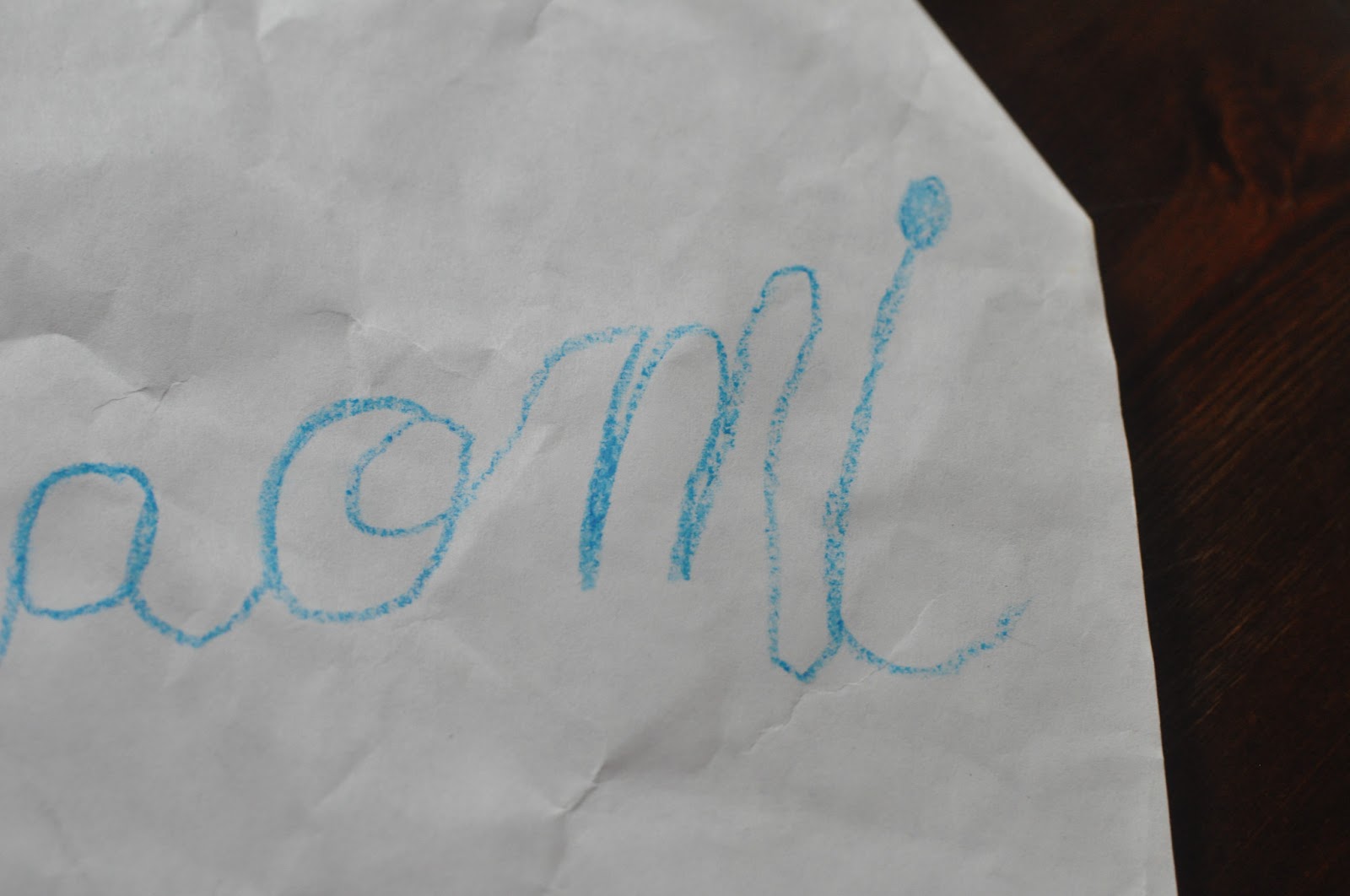
The entire process is just beautiful.  I miss seeing it in the classroom and I miss seeing the small steps in which my child must be blossoming in the classroom.  It was a total surprise when last week I saw her writing her name in cursive on a piece of paper.  It all happened so quickly.  She still has trouble recognizing and remembering some letters, but I know that it will click as she continues to repeat and practice writing.  In the past 6 months she has been recognizing letters here and there and points them out trying to read.  Gradually, we have noticed that she is trying to read whenever she can.  Sometimes when we read at home, she wants to read a page or a sentence.  I allow her to as much as she can and to the best of her ability.  These are times when I also explain that two O's make the sound "oo", or something like that.

It's hard not to be excited and happy for your child when they reach these milestones.  There is so much joy in them that it fills your heart with joy and in many ways, pride.  I'm not sure why we are proud, but that is the word we often use, and it's silly.  What right do we have to be proud of their abilities, but it is the way it is, and it is true.  I guess that's part of being a parent vs being a teacher.  In my home, I'm my child's parent and not her teacher.  This I had to accept early on.  I burdened and guilt-ed myself for almost 9 months trying to think of the right way to be when I realized I had to let go of being a "teacher" to my child and just be her mother.  This freedom was the best thing as I allowed myself to make mistakes and learn from them.  It allowed me to enjoy her and enjoy the process of being a parent.  The pressure to be "on top" and be prepared before her is impossible when you are a new parent and a first time parent.  In many ways, we are learning as we go.  There are lots of things we can be prepared for and we should, but when it comes to our own children and how we respond to them, we learn our threshold and our abilities at the given moment.  It's ok to recognize and embrace it.  We are human, just as our children are.  We too are still learning.  Life is far too short for perfection, so enjoying the journey is far more satisfying.

 These are from yesterday.  As you see in the corner, this is a sandpaper letter from my mother tongue.  Montessori comes in all languages :)
 Notice, how in the previous photos she spelled frog with the "r" and here she did not.  Also, this time, we used objects to bring a new interest to the activity.  This also allows children to work independently.  The last one is supposed to be "okapi," but as we all know there are two letters in the for the "K" sound.  Again, a point in how you don't need to correct and it will come naturally later on.  Best part, is it has the little one saying "okeeepee" around the house! 

 I'm trying to keep some anonymity to my children, but let's pretend you don't know her name and just recognize her handwriting instead :) 


Shared on: wildcrafting wednesday, simple lives thursdays, small footprint family, fresh eggs daily, Fresh Bites Friday, Wednesday Fresh Food,  Sunday Parenting Party, hip homeschool moms,  Living Green Tuesday, Montessori Monday,  Food Renegade, Eat Make Grow, Mums Make Lists,  Learning for Life,

Friday, February 8, 2013

Using a utensil- practice activities.


The simplest act of using a utensil begins when we introduce solid food.  I started both my kids around 6 months.  I loved the IKEA play set which contained real spoons and dishes.  They were the perfect size for infant portions.  As the gained better motor coordination, I gave them one spoon to their hand and I fed with another.  Soon, as they developed their abilities they were able to eat on their own around 12-14 months.


The emphasis for utensils is cultural.  Dr. Montessori pointed out that we are a product of our time and place.  Where and when we are  shape who we are.  Forks and spoons are a huge part of the Western etiquette for proper social behavior and table manners.  As an adult, it is our responsibility to help our children learn these social norms to adapt into society.  Many other cultures, including my own, use their fingers or chopsticks for meals and many different etiquette are part of those cultures and social norms. Because of this, I have allowed my children to both learn to eat with their hands and utensils, we're only now considering introducing the chopsticks to the 4 year old who has shown a great interest in it.  I'm working on getting the starter set!


Another aspect of table manners is also washing your hands before and after meals, and sitting while eating.  These are often seen as unnecessary or something that will come later as the child grows older.  Unfortunately, this is not true.  It is far more challenging to change habits when we don't start early.  Using wipes to clean an infants hands continues and a child then waits with their hands outstretched for it to be done for them.  Instead simply carrying them and washing their hands under running water will be as effective.  (I hope to do a pots on Washing Hands soon).

When I was teaching I had a little boy who was almost 3 whose mother asked me if she could come in at lunch time to feed him. I explained that it would be best for him to learn to eat on his own and by being with his peers who varied in age he would adapt quickly.  She called me everyday for weeks to see how he was doing.  When I said he had a lot of trouble sitting down for the meal she asked me if I would hold him and feed him.  I explained this would be impossible and it would be unproductive to his development.  It took a long time for this little boy to adapt, mostly because he wasn't expected to do the same at home.  He was fed all meals either in a high chair, or dinner which was in front of the TV so he wouldn't walk around as much.

My point in this story, is that it is in the home that the child learns the most basic and vital life skills that will serve him for the rest of his life.  Taking a little extra time and effort in the early years will benefit them greatly when they reach adulthood.

I was told a few years ago by a very close friend that she felt ill equipped with carrying on simple things like cleaning and cooking and how to care for herself as an adult because most of her life her mother did everything and never asked that the children help out. (see Road to Independence)

In many ways, we have to let go of things being perfect all the time, or things being messy, or things not being done the way WE want.  It's not about us, it's about the child and what's best for their development.  The only thing that will be perfect is the joy the child will have when he knows he did something all by himself.


 In this "presentation" two similar bowls and a small spoon are set up as above.  I spooned all the peas from one bowl to the other very slowly so that she could see my movements.  Once I was done, I moved the bowls back from full on left and empty on right, and then moved the tray in front of her so she could carry on. 
 This is a lesson in the Primary classroom, it's usually for a child between 2 1/2 to 3.  My little one is just 2 but I was aware of her abilities and felt confident in giving this to her.


Towards the end, she ended up pouring the grains from bowl to bowl.  Depending on who you ask, some might say to stop the activity, but recently when I attended a refresher course, it was also pointed out that if the child is engaged and seems to be concentrating and "working" then we should allow them to go on.  If they are misusing by banging and throwing then there is no purpose and it would be wise to ask them to clean up.  As you can guess, after a while the peas ended up all over the table and floor and so it resulted in cleaning up.


Shared on :For the Kids Friday, Share it Saturday,   hip homeschooling moms, Small Footprint Family

Wednesday, December 19, 2012

SHARE - the forced politeness

Share.  This is a word an infant hears repeatedly probably before they are even crawling.  A word that is said, over and over, and over and over again.  Share.  Share your toys, share your space, share your food, share your love, share your mommy, share, share, share.

Today, while I was in the playground I heard a grandmother (I am assuming this) tell the child, "SHARE!"  2 second pause.  "SHARE!"  "I said SHARE!".

I write it in caps and punctuate it as I heard.  So, if this is what I hear as an adult, can you imagine what the child hears?

I know I'm totally out of the box, down the road, across the hills, and deep in the woods, when it comes to this idea that we have to tell, yell, and force our children to share.  I don't think it's natural.  It's not.

Dr. Montessori talks about how the ages of 0-3 are when the child is developing his sense of self, also called Ego formation.  In this very fragile state he is building his sense of self unknowingly. It is an unconscious process in which the child absorbs the environment which includes behavior and social etiquette.  She also says that at this stage the child cannot "obey you" because he is listening to his inner teacher or his Will as she calls it.  The child's will is to develop himself, his strengths, his motor coordination, his ability recognize and categorize, and so much more.  At this stage, while all these high functioning processes are going on in the brain, he is unable to put himself outside of his body and consider how his actions are impacting the child next to him (who for the most part is a stranger in the playground).

It is essential and very important that we integrate and socialize our children to the culture in which we live, however, there is time.  The time comes just after 3, closer to 4 when the child starts to realize how his actions are impacting another.  After 3, the child has a conscious mind, a mind that seeks to learn from you, become a concrete thinking relating to his/her environment.

So, how do we get from the formation of the ego to a well adjusted and considerate child?  By modeling that behavior ourselves.  If we are polite and courteous to others, if we smile and open a door to another adult or child, if we offer assistance to another person, if we use words like "please," "may I," "thank you," and truly embody the sentiments of compassion and consideration to a fellow human being, then just then will our children become aware and understand what "share" truly means.

It saddens me to see what rude adults we become, sheltered in our own world, self-reliant, self-absorbed, self-centered, and all the while believing we are better for it.  Believing that being this way is being independent.  To me, independence is also knowing when you need help, knowing the difference between solitude and solace, empathy and sympathy, reaching out to others, and being true to oneself.

If we are to demand our not crawling, not walking, not talking children to SHARE!  Then maybe we should start by demanding the same of ourselves.

If the notion of sharing is that of; walking a mile in another man's shoes, then we should start by taking small steps in our children's shoes.  Understanding the complexity of an adult world through their eyes would be far better than forcing them to SHARE!

Shared on: wildcrafting wednesday, simple lives thursdays, HomeAcre Hop,  small footprint family, fresh eggs daily, Fresh Bites Friday, Wednesday Fresh Food,  Sunday Parenting Party, hip homeschool moms,  Living Green Tuesday, Food Renegade, Eat Make Grow, Mums Make Lists,

Wednesday, December 12, 2012

The Road to Independence

Independence is a word many parents adopt into their vocabulary early on.  From the start we all want to help our children become "more independent".   Independence, however, is not given or earned, it is a quest of the human condition.  Dr. Montessori stated that Independence is psychological and biological.  Therefore, as parents and caregivers to these human beings that are newly entering the world, we must respect that need for independence and allow the child to come to his/her full potential.

We do what we can with what we have (financially and with physical space). We didn't have everything we wanted for our first, we accumulated items along the way, and have a wish list that we ask our family to consider for birthdays and holidays.


Here are some ideas on helping your child become more independent based on things that have worked for us:

* Have all items they will need in a low shelf so that they can help set the table, get their bowls, plates, spoons, cups, on their own.

* Use real plates, glasses, cups with handles, forks, etc that are child size so they can feel a part of the family and learn good manners along they way rather than struggling it with it later.


*Keep a routine (vs. a schedule).  A routine will help a child know what comes next.  Keeping to the same order of things at each meal, cleanup, getting ready for bed, making the bed, getting dressed, etc, will allow them to repeat the same actions over and over thus perfecting that skill.


* Start with small and basic steps.  When helping a newly walking child clean up, give them the spoon or fork to take to the kitchen.  When they have mastered that, they can then take the cup, and once that is mastered, they can add on carrying the plate, and disposing of the remnants in the trash.  (This is a larger topic which I will expand upon in part 2)

* Set up the child's room so that they know where their things are.  Keep all clothes in low shelves so they can pick out their clothes and dress themselves.  Both my children (very strong willed), loved to pick out their clothes and get dressed by  18 months.  It tries my patience frequently at their choices of attire, but in allowing them the freedom to choose and become independent, I must let them make those choices which are also times they can learn a lesson from- like wearing not enough clothing on a cold day.
 I had hoped to make picture labels for each cubby, but within 2 weeks both children by 18 months knew which drawer had what clothes.  At first the entire thing was for my older daughter, now the top is hers and the bottom is for the little on.

*Washing hands and blowing noses.  Early on, as soon as they start eating, carry your child to the sink and wash their hands.  The routine and consistency of washing their hands in water will help them to have control and independence to do it on their own when they start to walk and are able to get to a sink on their own. Think of it as saving the environment from all those wipes.
 I realized my mistake when I took this picture.  For months we've had a small bar of soap, but recently, we put this giant one and the little one had such a difficult time holding this.  The hotel bars are perfect for them. We also prefer bars of soap over liquid.  Less waste.

*Have appropriate size stools or step stools so children can reach up to wash hands, brush teeth, and help out at the counter.  Do not put their dishes up high and have them climb up, instead move the dishes lower so they can hold them while having two feet firmly on the ground.  

These chairs are great for them to be able to get up and down on their own when sitting at the dining table.

*Give children the opportunity to help in the kitchen to prepare food, set the table, and cleanup all areas of the house.  Having child-size brooms, dustpans and such will enable them to be successful.


*One ability must be mastered before being challenged with a new one. Challenges not obstacles was a constant reminder to us when taking the course.  When challenged there is a new skill to be learned.  When an something becomes an obstacle, we tend to give up or feel inadequate. Mastery of a skill will help the child feel confident so that they can readily acquire new skills.  

* We cannot expect children to know what to do just by telling them.  We must demonstrate, even if it means letting go of control, and slowing down to a pace that is comprehensible to them.

*Practice a task yourself putting yourself in  your child's shoes.  This will help you to know how to present the activity to your child.  When carrying a glass, use two hands holding it carefully and walking slowly.  Children will imitate this behavior and you can encourage them to walk slowly so they can be successful by not dropping it.


Most of all, be patient and slow down.  Life is difficult for us as adults, having children adapt to a grownup world is challenging for them, so it's up to us to sometimes change our world to adapt to their needs.

Also check out cooking with kids for ideas in the kitchen and with food prep, and freedom and discipline on the importance of responsibilities which ultimately lead to independence.


Shared on: hiphomeschoolmomssmallfootprintfamily. Sunday Parenting Party, fresh eggs daily, Kids in the Kitchen,  mums make lists,
Living Montessori Now

Friday, November 16, 2012

The Importance of Practical Life.

I was talking to my daughter this morning as she was grumbling and having a fit about being too tired to put on her clothes by herself for school. In somewhat of a rant and lecture, I went off on her about how she has to stop saying "it's too hard" and "I can't do it". I kept telling her that she can, and she has to and that no one will help her if she can't help herself.  It was something that I thought important enough to write down.

I said, "You can do anything you want, you can build a plane, you can fix a house, you can do anything you want if you just tell yourself "I can".  But first, you need to learn how to dress yourself and get yourself ready for the day.  If you can do this by yourself, then you will learn to do anything on your own."

After thinking about it for a short time I realized, ah, yes, this is why Practical Life is so important in the Montessori environment.  This is where we give them the tools to do it on their own, the ability to be confident in themselves and their work, to move forward from caring for yourself, to caring for others and the environment.  Being able to care for yourself has more implications in the greater realm of life than we can put down into words.

I have so much more to write about this as I have been documenting in photos all that we do at home and how our home is set up to help them become more independent.  Of course, then we have days like today, where I want to pull out my hair and wonder what is going on that she can't do it on her own when she's been doing it all by herself since she was 18 months.  Well, the answer to that came when I thought, I've been working with 4 year olds for years, but this is my first time parenting one.  This, is completely a different process.  My friend reminded me how at 4 they come to realize they can do so much, ask the most amazing and profound questions, and realize the world is so much bigger than they knew before, and this, this very thing is what makes them come back to you and want to be held and comforted.  In some ways, they are unsure and not quite ready to face it, and rather than pushing them, I need to be encouraging and loving, and go back to the way I am with my little one.  Slow, and small steps. 

Wednesday, October 10, 2012

Kids on the GO!

I often wonder how other mother's do it.  They seem to have time to be dressed beautifully, have all their stuff in toe, and be happy (or appear to be).  Now, I'm fully aware that that's my perception and it's hard on us all.  I wonder what it's like at home for other mothers.  I often hear, "oh it's too hard, so we're always out," or "yes, that's why we try to keep busy and stay out of the house."  Hmmm....  This has had me thinking, and re-thinking over the years.  This was something that came up with the first and now again with the second.  I tried for a short time to pack up and get out of the house as often with my oldest.  Now with the second, it's less likely since we have to go pick up the other one from school mid-day.  So, this is my schedule but I kept thinking there's more to this.  Why am I so hesitant to do this? Why does this NOT fit my life-style?  What is it that's preventing me from being a "park/playground mom"?

Over the past few weeks I've been taking myself out of being "me" and being tied down the the "drudgery" that I've felt in our daily activities.   I've tried to look at it in another perspective and in the last two days it hit me, or rather I reminded myself why I'm doing what I'm doing.  Yes, there was a reason I didn't think I was going to send my kids to the Toddler class.  I was home, so I was going to do these things myself.  I was going to show them how to eat at a table, sit down when eating, clean up, put their shoes on, help them become toilet-trained, help them get dressed, help them learn how a home functions, and how to function in society.  Aha! Eureka.

So, why do I stay at home and not roam all over town to a new park each day.  Well, we try to get out, to go to a museum, to go on a hike, to play at the beach, or visit the library, and lots of trips to various grocery stores.  However, there is a very crucial stage in which children need to be at home or a home-like environment which provides the necessary activities to become independent.  They need to be comfortable and know where things are.  If their environments are to be changing daily there is no structure and therefore no routine.  Children like to have order and they actually crave it.  They like to know where their things are and where things belong.  They like to know what is expected of them, to have a routine, to have some discipline (see freedom and discipline ), and to become confident in that environment.  Many changes and constant change sometimes leave children lacking confidence in their environment and therefore their abilities.   It is the age before 2-2 1/2 that we must provide structure so that as they grow older they can become accustomed to changes since they become confident in who they are and what they are capable of. 

I'm not saying that we must be locked up in our homes and stay here all the time.  Not at all.  Children should become part of our daily lives and activities. They should go to the grocery store and see the things we buy for our meals, they should become part of that process and allowed to help.  They should go to the library and pick out their books and hand the library card and put the return books in the bin.  All these things I hope to discuss in another post I've been working on.  We need to help children become part of a daily routine which is meaningful to them.


However, instead of constantly taking children to the playground, park, children's museums, jump houses, aka child-oriented activities solely, we deny them of the opportunity to learn and grow.  All of a sudden as they age, we expect them to know how to put their clothes on and to be toilet-trained but never giving them the opportunities along the way to develop these skills slowly.  Toilet training should not happen in a week or so, it is a gradual process and one that requires clean up, knowing how to change out of wet clothes, put them into something, and to find new clothes to change into.  All these things must also be ready and in a place where they have access to.  Now, as I write this, we have been having lots of misses and also lots of successes. I'm still in the process of setting up the little one's environment. 
 
Changing underwear


The stable home environment (or daycare/preschool) allows children to be active and productive if it is set up in such a way.  They can explore and discover many new things, and they can exercise their skills consistently.  Knowing that they must sit down to eat a meal, clean up, wipe up, sweep, carry dishes to the sink, or dishwasher; these are all things you can do in a stable environment and not in a park.  Often when we are out, foods are finger foods, hands are not washed, utensils are not used, and dishes are plastic bowls or sippy cups. This will happen, this happens when you have a picnic, and that's great, it's healthy to get out and to do something different, but for this to be a daily routine is not helping children develop proper habits.  Prior to the age of 2, food plays a central role in their lives.  It provides for many sensory experiences.  I loved Michael Pollen's statement when he said that what distinguishes humans from animals is that we eat food, and not feed.  There is a social aspect to food beyond the need to fill our stomachs.  Children go home for lunch, or mostly eat at home.  Eating in public spaces is not a very common thing in most cultures either.  The idea of fast food, and eating on the go is predominant an American thing, but now we've just adapted it to eating "healthy" food on the go; juice boxes, milk boxes, goldfish, carrot sticks, string cheese, etc,


Cleaning up and taking care of an environment, knowing to put away and to put things where they belong, knowing to care for yourself, your appearance, your hygiene; these are all things that are best done at home.  A 5 year old who is put on a changing table in a public restroom is not something you will see in the rest of the world.  We have been staying home mostly these days as the little one (20 months) has been wanting to use the toilet.  Mostly we have misses, but on a day like today, there's been a lot of positive results as well.  It's never consistent, and as difficult as it is for me, I have to do it.  The loads mounds of laundry are unbelievable.  The cloth diapers she once used are now used to clean up the floor.  We're going through underwear sometimes 3 in an hour.  We also decided to stop using a diaper on the older one (4) 2 months ago.  So, we are also dealing with night time bed wetting with sheets, down comforters, and pillows being washed daily.  My mornings are spent running out to the garage and in the back yard to hang up the loads and loads so that it will be dry by evening.  Yes, to add to the stress, we do hang the laundry out to dry.  We use the dryer about 4 months out of the year in the winter months when there is little to no sun in the backyard.

By no means is this madness for all, but there is a reason why we do what we do.  Again, I will address sustainable living in another post.  However, as a society, all we are teaching our children is to become individuals on the go.  When we do that, we are also teaching them to use more resources than necessary.  Even a young child uses more resources than they should.  When everything in our lives become disposable we prevent children from seeing the value in things. 

It is hard, it is beyond hard to sit patiently while they take 5-7 minutes to put on their shoes, but by no means does this mean I sit an watch or "police" them in how to do it.  We do it together.  I have little to no time for myself because each activity provides for an opportunity to learn.  Not always, as is the case now, she is happily playing with her doll and feeding it and swaddling it.  She has kept herself entertained opening and closing some boxes and bottles, cleaned it up and put it away, to then move on to another activity of putting her doll to sleep.

The entire day cannot be spent taking forever for children to do things on their own time. Of course not, we'd never get anywhere.  But, when we do have the time, it's best to show them how to do things even if it's one or two things a day.  Even if you're a working parent who has to be out the door early, we can still take our time for one thing and help them to learn that one thing for a week or two and then change it.  They don't have to learn it perfectly, after all what does that mean?  perfect only means for them to be able to do it on their own, it means giving them the opportunity to repeat, repeat, repeat.  If we constantly dress them, eventually they will learn to believe that they do not know how to do it and so will just stand and wait for you to do it.

Steps and Stages:  Help children in small steps. As young as 15-18 months, let children do 1 or two things and then gradually help them build up.  Show them how to do something and then allow them to do it as they can, but be mindful in how many steps it takes.  The fewer the better. 

When my older daughter was about 2 she insisted on picking out all her clothes.  OH MY!  I'm so glad we took lots of photos, but how adorable to see her in a skirt, pants, unmatching shirt and something else random.  When she started school the teachers asked us if she dressed herself as it was quite obvious.  Now almost 2 years later, she picks out her clothes at night and sets them out to dress in the morning.  It's not always smooth and there are arguments, and whines not wanting to get ready quickly, etc etc.

As I said, I will write a separate post soon about what we do at home and how our home is set up.  I hope this explains a little bit about why we don't spend our days out all the time.

When my first child was born, one of the first things my mom said was how her mother said, 'Children love to be at home'.  I thought she was crazy.  Over the years I see how my children love to stay home and play, they love to play with all the tupperware, my shoes, put random stuff in a push cart and go in circles, take all the plates and cups and have a "tea party" in the middle of the floor.  When we come back from a trip, no matter what time even late at night, they perk up and go running around looking at all their things. 

So, in my experience, and for my kids, they love being at home at certain times, and then there are times we like to go out.  This is our family, of course yours is different, so we look forward to hearing what you do and how you spend your days.  I love to get ideas from other moms and especially from other blogs. It's an ever evolving philosophy and way of living.


Shared on: honeyscreativehomemaking. ,
Small Footprint Family
Sunday Parenting Party
Mums Make Lists
HomeAcre Hop


Related Posts Plugin for WordPress, Blogger...