Showing posts with label writing and reading. Show all posts

Thursday, March 13, 2014

The Montessori Child at School and Home (3-6)


I tried to recap my discussion with parents into their ages, work at school and things they can do at home and things parents can do with their children.  This is really brief and a bit all over, but I hope it can help.

Breakdown of the Primary 3 year cycle in development, abilities, and capabilities.
1st year: (2.5- 4 years)
  • Allow them to do more at home: chores, getting dressed, helping out, cooking, cleaning,
  • Read with them and read at higher levels
  • Don't interrupt focus and concentration
  • Help them develop confidence- key to focus, concentration, and good work habits
  • Children are able to play alone at home and give parents time to work and do adult chores.  They need to become aware of patience.
  • They are being exposed to the sounds, and possibly the 1-10 quantities and symbols
  • As they are closer to 4 they will be introduced to larger quantities and the decimal system possibly with addition
  • Depending on the child they will be exposed to the sounds and the cursive letters that correspond. We introduce writing before reading in Montessori.
  • We help them refine their large and fine motor skills especially their dexterity in the fingers and wrist- it's a preparation for writing. (At home: work with flour to make dough, very different skill than play-dough).
  • We also help them inhibit their movements by teaching them control and coordination.  This helps them with self control.
2nd year: (4-5 years)
  • They are internalizing their work, don't push
  • May not be as focused at school, but they are learning from the others
  • Quantities, number symbols, large quantities, addition, and possibly subtraction will be introduced (depending on the child).
  • There is a lot of repetition, this helps "incarnate" their knowledge.  The repetition and the material gives them a firm grasp of the concepts so that once the next lesson is given, they are ready.
  • They will be working with the golden beads for a long time, maps, and other sensorial/ exploration work.
  • The moveable alphabet and beginning of writing is introduced along with phonograms (2 sounds creating a third "ch")
  • many are straddling the younger years with the readiness for maturity
  • Allow for independence
  • Introduce them to the concept of consequences and follow through
  • Implement chores, rules, and agreed upon consequences before incidents occur
  • Read with them and help them recognize their sounds and numbers (when presented)
  • Help them become patient and understanding by not giving into them or turning to them when they demand your attention
  • Start game nights, family outings, family dinners and cooking

3rd year: (mostly ages 5+)
  • Be consistent on your "rules"
  • Invite children to come up with family chores, rules, grocery lists, and also their own consequences
  • Begin to enforce patience by setting timers, or giving timelines. Reinforce them and make sure they know it or understand it before walking away.
  • Needs vs. privileges: help them understand basic needs and what they are privileged with in their lives. 
  • Consequences can be certain privileges being taken away- they must know this before.  Do not react, but enforce prior discussions.
  • Limit media to weekends and even then to an hour or less
  • Read higher levels, chapter books and help them build vocabulary
  • Read and then ask questions about content.
  • Parents can take turns spending time with individual children and ask them what they'd like to do, spend time to get to know your child
  • This is the year of leadership in the environment, they blossom and it's sudden.  Once they are on a path of abstraction (less materials), they move quickly.
  • Children are ready for larger questions to be answered, very curious, very scientific, showing readiness for cosmic education/ Elementary
  • Children will be exposed to addition, subtraction, multiplication, and division.
Regarding media:  I strongly urge you all to put it away and allow it on occasion.  It is EXTREMELY evident who watches TV and also when they watch it in the morning.  It is a huge distraction in their mind and their focus and concentration on the materials are lost.  If media is not good for a developed adult brain, think of what damage it is causing the young developing brain. 


 Chores, refining fine motor skills, helping out at home.
 Experiencing nature, and playing on their own, time to think and be creative
 Writing before reading. Children write with the moveable alphabet
 100 board.  Children practice the sequence of 1-100  and explore by learning patterns in numbers.
 Helping prepare a classroom meal by peeling garlic. Refining fine motor skills and contributing to the community.
 Controlling their impulses by observing a friend with hands behind their back.
 Associating quantities of the decimal system with their symbols
 Working with flour and dough at home for refining fine motor skills and helping with chores.
 Counting 1-10 and associating a quantity with it.
A very young 3 year old refining his motor skills with nuts and bolts.

Sunday, November 17, 2013

Handwriting: The importance of repetition and perfection.

A few months ago I wrote a post about cursive and the art of handwriting.  I had not yet re-entered the classroom when I wrote it.  Now that I've been there for almost 3 months, it is something I see as essential.  My experience thus far is difficult to write in a short post, but what I will say is how it has made me love and appreciate the Montessori materials and philosophy even more.

From my experience before and now, and even seeing my own child's development in language and handwriting there are somethings I have come to realize.  I will try to summerize.

Today language is viewed as reading.  It's more important to read than write.  Whereas in Montessori, we teach children to write before they read (another post I wrote).  I see that reading is vial in most traditional education since children need to read and comprehend for test taking so they can color in a bubble.  Not to simplify this issue, but it has come down to test taking and finding that right answer, so reading and reading comprehension is valued over writing abilities.

The results are valued rather than the process.  Not so in Montessori.  In our classrooms you have all the time in the day/week/month to work through the task.  There is no rush.  We invite the children to take their time, take care and pride in their work, take the time in between to work on something else, and work on things at their pace and pleasure.  It is not a task to be crossed off a list or be weighed down by.  It is the process of doing, and re-doing (repetition) that builds the synaptic network.  A young child is joyous when doing a task that is of interest to them.  This is part of what we call "following the child".  We are guided as teachers by their interest and so we provide them the opportunity to further their interest in that field.


Bringing home "work" and homework.  Often we find ourselves telling parents not to give children workbooks and apps that "help" children learn at home.  This is mostly because when a child is doing all this work at home, coming to school where they have freedom to choose their work and friends gives them the opportunity to also choose to socialize instead of choosing work.  Mostly because they are already exhausted from working at home.  Every child needs a break from work.  This is why you will see a child working for hours with the moveable alphabet or the addition strip board and after they put it away, they are calm and collected and choose "lighter" work where they color or do some sewing, or just sit and watch others work.  They need that time to process what they have done. 
So, why do Montessori children not bring loads and load of paperwork?  Two reasons; 1. Dr. Montessori was an early conservationist.  She believed that we do not need to waste.  She found that using materials like the sandpaper letter, moveable alphabet, and other hands-on materials allowed a child to work and not have pages and pages to take home. 2. The children perfect their work in the class with the materials, with the chalkboard, they practice their handwriting with the sandpaper letters and various alphabets, then when they are ready, the take out a small piece of paper and transcribe their intentions and ideas onto that paper.  As they become more proficient, they can lose the materials and simply move onto paper, but that takes 3 years of being in a classroom. 

Handwriting.  As I wrote and copied the authors essay in the handwriting post, handwriting is a lost art.  Children are comfortable and choose to write in print.  They see print around and find it easier to copy.  Handwriting is not simply about copying written symbols, but a means of expression.  Just as it is individual and personal so should our handwriting be.  It is an expression of who we are.  The typed/ printed word is static even with the myriad fonts out there.  A handwritten note is still valued over a typed email, why?  The personal touch.  So, why do we not encourage a young child to develop that ability and sensibility?
Is it really worth it and beneficial to teach a child the easy way or the short-cuts?  What are the long-term effects when we have adults who are lacking these skills, sensibilities, and executive functions?

One of the key philosophies of Dr. Montessori was “Never give more to the mind than you give to the hand.”  And this is why a Montessori classroom looks the way it does!


Wednesday, August 7, 2013

Cultural Exchange, Stamp Collecting, Letter Writing, and More...


Hello There,

Have you ever wanted to receive a package or letter filled with goodies, or something just fun.  Well, think of how fun it would be for your kids at home, or for you classroom. After looking into many (MANY) sites and exchange groups, I've decide to go ahead and set one up myself.  I'm not quite sure what I'm getting into and from the activity level on the Facebook posts, it's likely not much.  I'm hoping it's mostly due to lack of clarification on my part.  So, let's get into the details.

How will it work: 
Each month or quarter, we can come up with themes.  Based on this, individuals will exchange their home or school mailing address (get permission) and send appropriate items keeping a budget in mind.  We do not want anyone to feel burdened or feel that this is costing them an expense in participating.  The wider the reach the better- think global.

We can start with something basic like post cards or a simple letter with a unique stamp.  This will encourage children to write, keep a small journal of stamps, and track where the letters are coming from and going to.  This is a wonderful geography and culture lesson.  I'm really hoping to enhance my geography folders in the classroom through this.  Teachers, this is an ideal way to ask for something specific like photographs of monuments, or other cultural landmarks, costumes, food, native plants and animal, etc.  The sky is the limit.

As we grow and have a group we can figure it out better.  You will not be sending letters and packages to everyone.  Instead it would be one or two, and you would receive the same.

For international packages, you will need to check what is allowed as certain items are not allowed to be mailed (seeds, meats, cheeses, and such). But, we have time to get there.

If you are interested, please comment here, but be sure to join us on Facebook as that may be our fastest way of communicating for now. In your comment let us know where you're from, and if you hope to join as a family or as a school.  This way, it will help with whom to partner or exchange with.

Once a "session" or exchange is open, comment on there saying you're interested.  You will then contact the person before you and get their contact details.  You will send them the item of the session.  When the session ends, I will send the last person on the list an item. This way, everyone is covered and relatively in the order that you signed up.  Please ask questions if this is all unclear.  This is new to me as well, so we're working it out as we go.

As I said, for now, I'm going slow, so if you think you'd like a post card leave a comment here with your location.  Hopefully, we can get everyone mixed up and get a variety of postcards sent out.  Ideally, a PC from your city showcasing it's beauty would be best.  If your children can write, have them do it, if not, have them narrate it.

For stamp collecting:
Have a small blank or ruled notebook and divide it into continents.  This way you can put the stamps on the appropriate section.  If you want to be more organized, you can sub-divide, or for the US or your own country, you can divide into States.

Theme ideas:
Local Post Cards
Unique stamps, with a simple letter and photo of your city, school, local building, etc
Pressed leaves or flowers unique to your region (photo if not)
Flag of your country - and anything else you'd like to add
Buttons or pins
Songs sung at home or in classroom
handmade craft
yarn, felt, fabric, or something to create
Favorite recipe
Local Sweets, or Chocolates (keep in mind allergies)

So, I open this up for your comments, suggestions, feedback, finger-wagging, nods of approval or disapproval (negativity shall remain in your own domain).

I hope to have at least 1 successful and fun run with this.  If it doesn't work then at least we tried.  No one says you need to do such a thing for life, even if a child recalls the 1 time he/she received a postcard or package from someone, it will remain with them forever.  Even if it's a notebook of 10 stamps, well then it's 10 more than he will ever collect again.  Trying is half the fun. 

Thank you,
Sincerely,
Home Grown Crew

P.S. No weirdos allowed.  Nothing graphic or inappropriate for children.


Note:  See above page tab for "details".  The first exchange has begun and runs through Sept 30th.  Join us on Facebook to sign up.  If you are a teacher and would like to participate as a class do let it be known. 

Shared on: More the Merrier Mondays, Eco-Kids Tuesday, Tuesdays with a Twist,  wildcrafting wednesday, Wildlife Wednesday, simple lives thursdays, HomeAcre Hop,  small footprint family, Friday Nature Table, fresh eggs daily, Transformation Thursday, Thrifty Home,  Fresh Bites Friday, Wednesday Fresh Food,  Sunday Parenting Party, hip homeschool moms,  No Time for Flash Cards, Living Green Tuesday, Montessori Monday, Farm Girl Blog Fest,  Food Renegade, Eat Make Grow, Saturday Show and Tell, Kids in the Kitchen, Learning for Life, Mums Make Lists, It's Playtime,  All Year Round Blog Carnival

Monday, July 8, 2013

Cursive and the ART of Handwriting

While rummaging through the garage this afternoon I found this piece of paper.  It really struck me since this too is a tad dated.  I think it's an important piece of information to share.  As I type this, it emphasizes the lack of handwriting and the loss of this art.  We are in an age where we type, skype, facetime, email, and text.  The use of our hands is limiting and limited.  We feel more "intelligent" due to the pace of technology and the information it brings us, but giving up  and under-utilizing a valuable aspect of our human development, are we really that much smarter?

There is a debate about writing and the use of cursive writing in the Motnessori classrooms.  Depending on when and where you did your training, you were taught to use either print or cursive.  AMI has now brought cursive back into the classrooms and it is how we teach children to write.  In a previous post I discussed why we introduce children to writing before reading.   In this handout below the author will explain why we introduce cursive to the young child instead of print.  I have typed the text as is, but italicized and bolded the text myself.


The Art of Handwriting
by unknown author and presented as a handout during AMI lectures.

Out of the Middle Ages came masterpieces of decorative writing.  Early manuscripts, such as the Book of Kells, were mostly products of Christian monasteries.  These illuminated manuscripts were written on parchment with a fine metal pen or a goose quill and were complete with letters decorated with miniature paintings made of rare pigmentation colors.  Until 1450 C.E. and the invention of the Gutenberg printing press with movable type, all writing was done by hand.  It was a painstaking and time-consuing task which required the hand of an artisan.  Fortunately, much of this work was accomplished by monks who thereby preserved much of the oral tradition of ancient times.  The beautiful decorations had the purpose of drawing the reader more deeply into the test, as if mesmerized by the written word.

Since the invention of the printing press, beautiful handwriting has nevertheless continued and is often considered an art and referred to as calligraphy.  In Japan, calligraphy is a highly respected art form and it is gaining greater appreciation in other countries as well, including the United States.

The recent wide-spread use of typewriters, word processors, the telephone and other technological advances have brought our present-day culture to neglect the hand-written word.  Handwriting is considered unnecessary, an obstacle to efficiency and old-fashioned.  Even today, however, we can derive a great deal of pressure from this very personal form of communication.  We are in a much faster-paced era, where we prefer to use the telephone instead of writing a letter, when we take photographs of trips instead of keeping a journal, etc, and as a result, we have come to tore easily form the use of a pen.  We no longer take the opportunity to let our innermost thoughts flow easily with a hand-written communication.  Our handwriting is such a personal experience that each person, with their own unique hand, writes in his or her own individual writing style.  All movement and gestures are a creation of our own unique personality. So is our handwriting.  Therefore, our handwriting is as unique as our finger prints.  Graphology analyzes a person's character, as well as his intelligence, from his handwriting. 

One of the advantages of handwriting is the possibility to write down our thoughts whenever and wherever we are.  We can bring to life a bland piece of paper with these magical little marks which the Phoenecians invented.  Even if we are not poets, writing can be everyone's craft.

In teaching children to write beautifully, we are not attempting to eliminate the use of modern conveniences, such as the typewriter.  We must prepare our children to live in their culture and use the technology of today.  However, the ancient art of writing will give the children an added dimension to their self-expression which they can use all of their lives.  The Montessori teacher herself must develop a consistent style of cursive writing which will serve as a model for the children.  Much of the teacher-prepared material in the environment should be in beautiful cursive style and we must take every opportunity to expose the child to cursive writing.  Even letters to parents, messages and signs for the class should be in cursive style.  Whenever appropriate, the written message should be decorated in some way, using a colorful border of some type.

One should use the exact same cursive writing style as is used in the local country or region.  The cursive alphabet to be used is usually easily available on written tablets sold in local school supply stores. 

We are often questioned as to why we introduce the young child to cursive rather than manuscript (printed) letters.  Here follow some of the reasons:

  • The young child is in the muscular-tactile stage when he enjoys manual activity. 
  • The hand does one continuous movement left to right with cursive.  
  • The shape of the letter is easier to write in the flowing cursive form and the sandpaper letters are easier to trace in the natural flowing style.
  • Because of the continuous movement from left to right, children do not reverse letters as easily, such as do children who have inclination to dyslexia.
  • The hand is lighter in the flowing movement and therefore does not tire as easily.
  • The child is in the sensitive period for small detail, for refinement of movement and for language.  This unique natural combination is the ideal time for the child to begin writing.  Cursive writing allows the child at this stage to enjoy the process of writing, not only the finished products of the written message.
  • Children are very susceptible to the art form of writing: thy are attracted to beauty.
  •  All letters begin on the base line, and with few exceptions (dotting the i and crossing the t), the child need not pick up the pen.
  • Compared to manuscript letters which have many of the exact same ball and stick characteristics, the cursive letters are shaped more uniquely and therefore are easier to differentiate from one another.
  • The child can easily pick up the manuscript form of writing after he has mastered the cursive style. 


The Illuminated Letters from the 8th Century Book of Kells

Reading this document made me realize how much has changed since then.  Typewriter?  Oh my!  That has become as vintage as writing except that both have been used to create new typeface and a new following has come out of it- I suppose.

Also, just typing this out has caused both my wrists to lock up and made me think about how carpal tunnel is now a huge issue.  As I paused to give my wrist a break, I moved my hand in a cursive motion and noticed the ease and fluidity and relief it gave my wrist.

So, what's the purpose of this post? I hope it just gives you something to think about and also some insight as to why we teach children cursive in most AMI schools today.

I hope this inspires teachers to use more art in language, and I hope it inspires more parents to take away electronic devices and allow their children to write more.  Keep a journal, write a letter, doodle, or take up calligraphy yourself.  Use your hands to create, and explore, and discover the possibilities of your personality.  After all, as the author says, our handwriting is as unique as our fingerprint, so, express yourself!

Shared on: More the Merrier Mondays, Eco-Kids Tuesday, Tuesdays with a Twist,  wildcrafting wednesday, Wildlife Wednesday, simple lives thursdays, HomeAcre Hop,  small footprint family, Friday Nature Table, fresh eggs daily, Transformation Thursday, Thrifty Home,  Fresh Bites Friday, Wednesday Fresh Food,  Sunday Parenting Party, hip homeschool moms,  No Time for Flash Cards, Living Green Tuesday, Montessori Monday, Farm Girl Blog Fest,  Food Renegade, Eat Make Grow, Saturday Show and Tell, Kids in the Kitchen, Learning for Life, Mums Make Lists, It's Playtime,  All Year Round Blog Carnival

Wednesday, June 12, 2013

Reading With My Kids

I have to admit I was not an avid reader as a child.  I loved books and loved looking at them, but I wasn't a "bookworm".  I preferred my mom reading to me.  I used to love short stories, The Famous Five, and Charlie and the Chocolate Factory to name a few.

However, as I've grown older and started working with children 15 years ago, I began to familiarize myself with lots and lots of children's books, many which have been written since I was a child.  I have found that the books today go far beyond fairy tales and orphans.  Many of the books I grew up reading ended up having a sad and frightening message for children.  Working with young children for most of my adult life, I've ended up in many book stores and libraries.  Finding new books to read to them (and myself) have been a joy.

I have to say it really came into full gear when I had my first child.  Around 16 months she was captivated by 20 page books.  She wanted no part of the 1 word books and images.  I don't recall ever getting those for her.  She loved stories.  She still does.  We used to go to the library once a week and pick out books together.  I'd have her take the books out of our bag and drop them in the return bin.  It was a ritual.  I think reading to her and seeing her love books has energized me and given me a new love for reading.  My favorite time with my girls is snuggling in bed and reading a stack of books.  It makes me happy that my second one is also a lover of books and can share some of the longer stories with her sister.

 Above: What Happens on Wednesdays.  Below: We All Went on Safari, and  I know a Rhino.
 Some of the books we were reading at 16 months and the older one signing as she flips through books.


I do have requirements when picking out books both in the library and online.  I LOVE the reserve feature since I can cross reference books from Amazon and then put them on my library list.  Once we have read them, the ones the kids and I enjoy are then shared on My Library Thing on the right side of this screen.

My requirements for books:
- people vs. animals for characters (there are many exceptions depending on the story)
- beautiful images
- interesting stories of people, culture, places, historic figures
- topics we have talked about, traveling to, or experiencing
- gardening, nature, food, cooking, biographies, science are a few of the topics
- re-read books depending on the season, holiday, or pure enjoyment
- we avoid Disney, Sesame Street, Fairy Tales, Dora, Spunge Bob, Bob the Builder, etc
- Curious George has made it into the house but only the newer ones, it started as a gift and now it's a recognizable character (hence my weariness in starting with the above mentioned ones).
- we read at any point in the day, but select only 2-3 at night time and then lights off no matter what.


As you will note from my frequent Facebook postings on books we are reading, I like to share the books we checked out and my thoughts on them. Currently, I have maxed out our checkouts and have another 13 on a wait list.  I hope not to turn the passion into an obsession.  We check out many of the same books at least a few times a year.  I try very hard not to get behind on returning or renewing, but it does happen.  I often joke that I've managed to keep 1 branch open with our late fees (honestly, it's just a joke).

I have stopped asking for books as gifts and we try to stick to the library as much as possible.  The occasional book is given and we love it, it's just finding a place for it in this small house that is becoming a struggle.  
 My first sewing project- the books sling where we keep the library books (it's just not enough anymore.)
 We try to stay organized by keeping library books in the room and our books on the bookshelf in the living room.  TRY is the key word.

If you get a chance, check out our Facebook page for book reviews and ideas for new books, and keep in touch to get updates on all new book postings.  This is easier and faster than blog posts.  Usually I post 2-3 books per week.


Shared on: More the Merrier Mondays, Eco-Kids Tuesday, Tuesdays with a Twist,  wildcrafting wednesday, Wildlife Wednesday, simple lives thursdays, HomeAcre Hop,  small footprint family, Friday Nature Table, fresh eggs daily, Transformation Thursday, Thrifty Home,  Fresh Bites Friday, Wednesday Fresh Food,  Sunday Parenting Party, hip homeschool moms,  No Time for Flash Cards, Living Green Tuesday, Montessori Monday, Farm Girl Blog Fest,  Food Renegade, Eat Make Grow, Saturday Show and Tell, Kids in the Kitchen, Learning for Life, Mums Make Lists, It's Playtime All Year Round Blog Carnival

Tuesday, April 2, 2013

Writing (in cursive) Before Reading.

In a Montessori classroom we say that after a child learns his/her sounds they are introduced to writing before reading.  It is usually the opposite from traditional schools.  After they have learned their sounds with the sandpaper letters they practice on a chalkboard.  Then they are introduced to the moveable alphabet.  This is a box that contains cut outs of each letter with consonants in pink and the vowels in blue.  AMI training these days encourages cursive handwriting due to the natural circular motion.  There are many exercises prior to language that prepares the child and helps them develop their gross and fine motor skills so they are ready.

There is also a lightness in touch where children learn not to press too hard when they write in cursive.  Observe a child who writes in print and you will notice that there is a force in which letters are written.

I had purchased a moveable alphabet years ago when I had thought I would be doing a different project.  It ended up not working out and so I had it at home.  Once my daughter started using it at school and noticed the one I had at home, she wanted to practice at home.  I do not make her practice any of her lessons from school at home.  The beauty of Montessori is that a child learns at his/her own pace and the classroom provides enough time for them to work at school.  This is also why Montessori children never have homework- oh goodness, what a blessing!  So, when we did the moveable alphabet at home, she chose to write her own words and write them as she hears them.  This is where the "writing before reading" idea comes in.  When a child writes, they write what is in their head.  They write as they hear the word.  We do not discourage them by correcting their spelling.  The key is to develop the love and interest for learning and the desire to repeat.  Once they practice, then as a gentle guidance, we can help them recognize sounds they miss, or we introduce additional sounds that are created with multiple letters such as "sh, ch, ar, oo, " so and and so forth.  Then much later, do you help them with "spelling."  This step in learning to write before reading allows them to master the language so that when reading, it is smooth and they already know to recognize the sounds to "put together".
 These were taken back in January.  I did help her with the "ou" in house.
The last one is steller's jay, a local bird she loves.

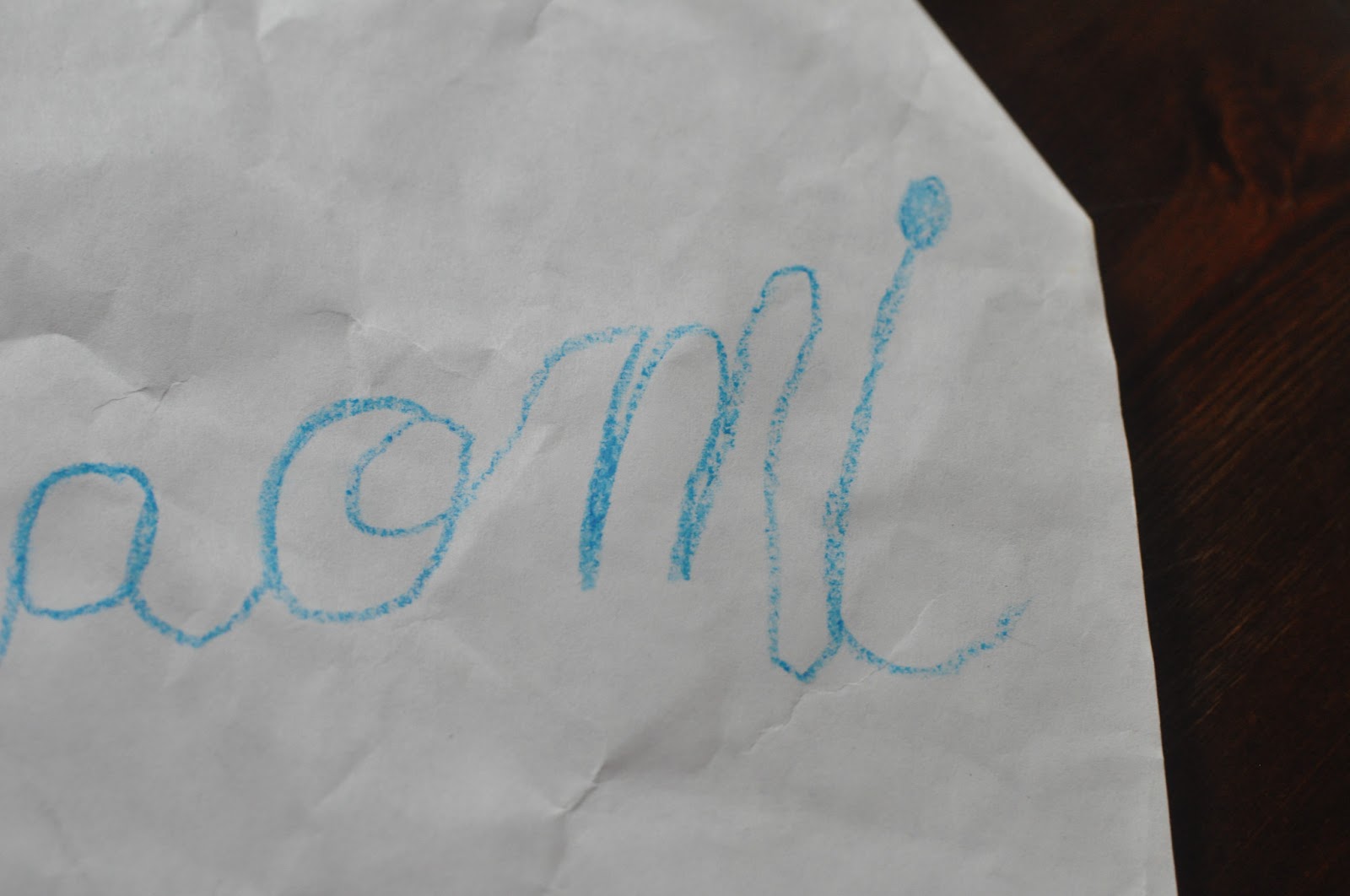
The entire process is just beautiful.  I miss seeing it in the classroom and I miss seeing the small steps in which my child must be blossoming in the classroom.  It was a total surprise when last week I saw her writing her name in cursive on a piece of paper.  It all happened so quickly.  She still has trouble recognizing and remembering some letters, but I know that it will click as she continues to repeat and practice writing.  In the past 6 months she has been recognizing letters here and there and points them out trying to read.  Gradually, we have noticed that she is trying to read whenever she can.  Sometimes when we read at home, she wants to read a page or a sentence.  I allow her to as much as she can and to the best of her ability.  These are times when I also explain that two O's make the sound "oo", or something like that.

It's hard not to be excited and happy for your child when they reach these milestones.  There is so much joy in them that it fills your heart with joy and in many ways, pride.  I'm not sure why we are proud, but that is the word we often use, and it's silly.  What right do we have to be proud of their abilities, but it is the way it is, and it is true.  I guess that's part of being a parent vs being a teacher.  In my home, I'm my child's parent and not her teacher.  This I had to accept early on.  I burdened and guilt-ed myself for almost 9 months trying to think of the right way to be when I realized I had to let go of being a "teacher" to my child and just be her mother.  This freedom was the best thing as I allowed myself to make mistakes and learn from them.  It allowed me to enjoy her and enjoy the process of being a parent.  The pressure to be "on top" and be prepared before her is impossible when you are a new parent and a first time parent.  In many ways, we are learning as we go.  There are lots of things we can be prepared for and we should, but when it comes to our own children and how we respond to them, we learn our threshold and our abilities at the given moment.  It's ok to recognize and embrace it.  We are human, just as our children are.  We too are still learning.  Life is far too short for perfection, so enjoying the journey is far more satisfying.

 These are from yesterday.  As you see in the corner, this is a sandpaper letter from my mother tongue.  Montessori comes in all languages :)
 Notice, how in the previous photos she spelled frog with the "r" and here she did not.  Also, this time, we used objects to bring a new interest to the activity.  This also allows children to work independently.  The last one is supposed to be "okapi," but as we all know there are two letters in the for the "K" sound.  Again, a point in how you don't need to correct and it will come naturally later on.  Best part, is it has the little one saying "okeeepee" around the house! 

 I'm trying to keep some anonymity to my children, but let's pretend you don't know her name and just recognize her handwriting instead :) 


Shared on: wildcrafting wednesday, simple lives thursdays, small footprint family, fresh eggs daily, Fresh Bites Friday, Wednesday Fresh Food,  Sunday Parenting Party, hip homeschool moms,  Living Green Tuesday, Montessori Monday,  Food Renegade, Eat Make Grow, Mums Make Lists,  Learning for Life,
Related Posts Plugin for WordPress, Blogger...