Showing posts with label lessons. Show all posts

Thursday, June 18, 2015

Monument Valley: Big Butes


Our first night in Monument Valley is one to remember.  We pulled into our campsite at Gouldings which was nestled between large butes of red rock.  The site had lots of trailers and a few tent sites which were close to each other.  The bathrooms were amazingly clean, lots of free showers, wifi, and and indoor pool.  What can we say?  Oh and the closest drive into the park.

Our night was so hot we decided to sleep without the rain fly.  Around 4 am I woke up to some large drops on my face and my husband rushed to get the rain fly on.  By then I noticed lightning.  It may not have been close, but at 4 am and in a tent, maternal instinct kicks in and you're ready to protect those babies.  I watched for an hour to see the lightning light up the sky and also make bolts that hit the ground at some distance.  By 5:15 and some light in the sky I was ready for a run.  Heading down the hill I felt I could have been like Forest Gump and keep running.  It was breathtaking and even at 5,000ft elevation, I was elated.

We spent the morning in the park exploring the butes, learning about rock formations, erosion, and also precious rocks.  The unpaved path in our Prius was doable.  We fretted about it and so we took our box and hitch off and left it in our tent.  It was a good thing since it was quite a bumpy ride but nothing the car could not handle.  I cannot imagine the kids putting up with the open and dusty jeep ride.  The park cost $20 and it was just amazing to drive by all those butes.  However, I will say that if you are strapped on time 163 heading S/ SW is the money shot.  You see a lot from there and this is the movie scene.  Hitting this stretch at sunset is the best.  The park is hot- very hot at this time but it was amazingly green on the valley floor.  I will say that as much as we enjoyed looking up, there was more to see down in the grasses.  The wildflowers were stunning and changed from one location to the next.  Not sure if we got lucky with some recent rains.

The other highlight of our campsite was that we discovered some trails into the rock right behind our tent.  This led to the most spectacular rock arch form which rivals some photos of Arches in Utah.  I'm sure they are amazing, but for a quick campsite hike this was a truly hidden gem.

The kids spent the afternoon cooling off in the pool followed by a fantastic pork massaman curry and coconut rice.  This was one of the pre-prepped packets of food I made before leaving (photo on FB).  Simple steps like this have really helped expedite meals and to also make them pretty great since I would not want to carry all these spices and veggies around for days.  Having it frozen and in the cooler has been a lot of help.  Hopefully I'll have a meal prep/ camping packing post ready by the time we're done with this trip.


If you like what you read, please check out FB for random and occasional photos.  Most everything is done from my phone, so service and spelling are spotty!

Thank you for visiting!

Oh and we stopped at an antique shop where I got an amber cake stand and a blue glass ball canning jar!
The View restaurant. Excellent view Nd break from the heat, ok on food. 
The 'mittens' left and center

An arch behind our campsite.


Dinner of pork massaman curry and coconut rice. Some awesome whiskey from San Fran. But that was a mistake considering our drive to CO. 

Monday, May 19, 2014

Notes from a Recent Campout

We went camping this past weekend and I realized I'm still waiting on updating my Camping with Kids 2 post.  In the meantime I wanted to share some notes on why it's so important to just get out and be in nature.

Last week, SD county was ravaged with 9 fires.  We evacuated our school and were closed for a day.   The heat in the city has been brutal with almost 100 degree days, and about 90 in the house as we don't have A/C.  Getting ourselves ready to leave after work on Friday seemed near impossible.  But we did it, and I'm so thankful we forged ahead and left our home behind, an utter mess.

With that, here are my "notes" I'd like to share.

  • Book a site and go
  • Plan ahead, but if you forget something, you will make do.
  • The more frequently you get out and go camping, you can fall back on the "usual" necessities
  • We have our camping clothes, so packing gets pretty easy and fast
  • Always be prepared for cooler weather.  
  • Going with friends helps in motivation and having a back up in case you forgot to bring things
  • Pack lots of drinks and snacks (adult beverages included).
  • Be flexible- things never go as planed and you just have to adapt and move on.  It's the best skill to be learned as a child and an adult and being in nature is the best test to this.
  • Take wipes and hand soap- I don't buy wipes for daily use or even around town. I hate the waste, but for camping, you just never know and it helps to have a small pack to rely on.
  • Head lamps and lantern are a must.
  • Pack a few books for bedtime.  Nature based books while out really ignite the imagination.  We read about monarch butterflies and we now hope to plant lots of milkweed plants.
  • Have a few dollars in quarters in case there are hot showers- helpful for kids who play in muddy ponds.  
  • Nature journal with pencils and colors for writing and drawing.


As difficult as it was for us to get out, it was worth it.  Watching my two run around with their friends and seeing how much fun they had getting dirty was worth it.   Being woken up to birds and woodpeckers- priceless.  Having my daughter wake up saying she didn't sleep well and the hawk woke her up- memorable.  Watching them play in the tent pretending to be princess astronauts - Ridiculous! Having them both brood and complain that they didn't want to go home- Worth it!

Nature discoveries that are impressionable lessons:
  • Baby dragonflies stuck to our legs 
  • Eared grebes only a few feet away from the children
  • Colony of ladybugs that have newly hatched and discovering them in the larva stage (click here for life cycle activity)
  • caterpillars in various stages of growth 
  • Baby lizards
  • Moss and lichen and the symbiotic relationship with fallen trees
  • Wild flowers in the spring

'Tis the season to get out and play.  Hope you find time to do so this summer.
p.s. I hope to get that second post out on camping soon- I promise!

 The children discovered a wild chamomile.  The flowers and smell were identical. 

 Some one had made a pretty cool house of bark and branches.
 The group we went with was almost 100 people. It was one of the biggest groups we've gone with but we shared a site with our friends and the kids had a blast hanging out together.


 Foil pack smores.  Let it be said that the 365 dark chocolate makes for excellent melting chocolate!

 Even when camping the children can help with chores.

We still need to look up what kind of caterpillar this is.

Tuesday, April 2, 2013

Writing (in cursive) Before Reading.

In a Montessori classroom we say that after a child learns his/her sounds they are introduced to writing before reading.  It is usually the opposite from traditional schools.  After they have learned their sounds with the sandpaper letters they practice on a chalkboard.  Then they are introduced to the moveable alphabet.  This is a box that contains cut outs of each letter with consonants in pink and the vowels in blue.  AMI training these days encourages cursive handwriting due to the natural circular motion.  There are many exercises prior to language that prepares the child and helps them develop their gross and fine motor skills so they are ready.

There is also a lightness in touch where children learn not to press too hard when they write in cursive.  Observe a child who writes in print and you will notice that there is a force in which letters are written.

I had purchased a moveable alphabet years ago when I had thought I would be doing a different project.  It ended up not working out and so I had it at home.  Once my daughter started using it at school and noticed the one I had at home, she wanted to practice at home.  I do not make her practice any of her lessons from school at home.  The beauty of Montessori is that a child learns at his/her own pace and the classroom provides enough time for them to work at school.  This is also why Montessori children never have homework- oh goodness, what a blessing!  So, when we did the moveable alphabet at home, she chose to write her own words and write them as she hears them.  This is where the "writing before reading" idea comes in.  When a child writes, they write what is in their head.  They write as they hear the word.  We do not discourage them by correcting their spelling.  The key is to develop the love and interest for learning and the desire to repeat.  Once they practice, then as a gentle guidance, we can help them recognize sounds they miss, or we introduce additional sounds that are created with multiple letters such as "sh, ch, ar, oo, " so and and so forth.  Then much later, do you help them with "spelling."  This step in learning to write before reading allows them to master the language so that when reading, it is smooth and they already know to recognize the sounds to "put together".
 These were taken back in January.  I did help her with the "ou" in house.
The last one is steller's jay, a local bird she loves.

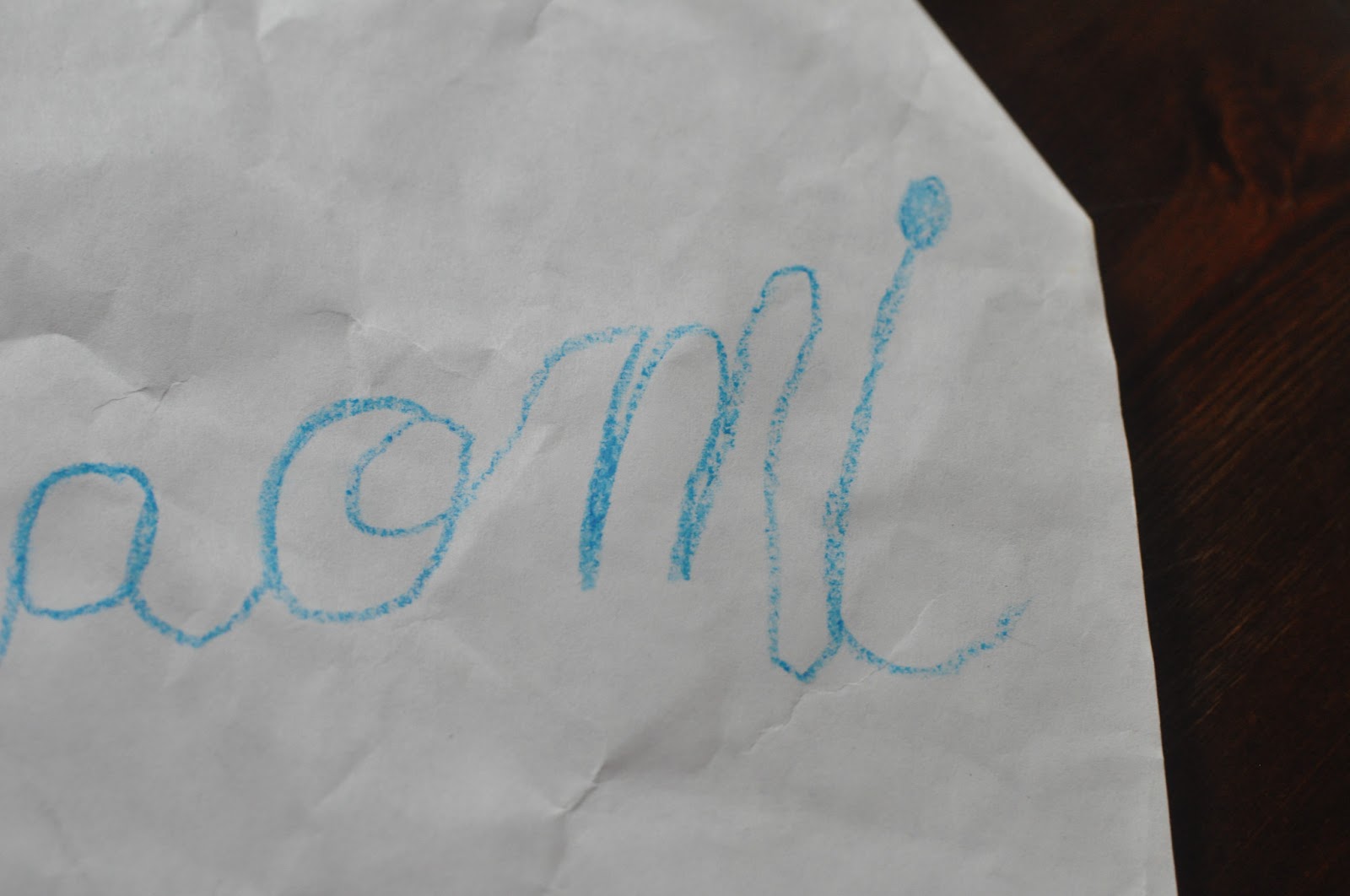
The entire process is just beautiful.  I miss seeing it in the classroom and I miss seeing the small steps in which my child must be blossoming in the classroom.  It was a total surprise when last week I saw her writing her name in cursive on a piece of paper.  It all happened so quickly.  She still has trouble recognizing and remembering some letters, but I know that it will click as she continues to repeat and practice writing.  In the past 6 months she has been recognizing letters here and there and points them out trying to read.  Gradually, we have noticed that she is trying to read whenever she can.  Sometimes when we read at home, she wants to read a page or a sentence.  I allow her to as much as she can and to the best of her ability.  These are times when I also explain that two O's make the sound "oo", or something like that.

It's hard not to be excited and happy for your child when they reach these milestones.  There is so much joy in them that it fills your heart with joy and in many ways, pride.  I'm not sure why we are proud, but that is the word we often use, and it's silly.  What right do we have to be proud of their abilities, but it is the way it is, and it is true.  I guess that's part of being a parent vs being a teacher.  In my home, I'm my child's parent and not her teacher.  This I had to accept early on.  I burdened and guilt-ed myself for almost 9 months trying to think of the right way to be when I realized I had to let go of being a "teacher" to my child and just be her mother.  This freedom was the best thing as I allowed myself to make mistakes and learn from them.  It allowed me to enjoy her and enjoy the process of being a parent.  The pressure to be "on top" and be prepared before her is impossible when you are a new parent and a first time parent.  In many ways, we are learning as we go.  There are lots of things we can be prepared for and we should, but when it comes to our own children and how we respond to them, we learn our threshold and our abilities at the given moment.  It's ok to recognize and embrace it.  We are human, just as our children are.  We too are still learning.  Life is far too short for perfection, so enjoying the journey is far more satisfying.

 These are from yesterday.  As you see in the corner, this is a sandpaper letter from my mother tongue.  Montessori comes in all languages :)
 Notice, how in the previous photos she spelled frog with the "r" and here she did not.  Also, this time, we used objects to bring a new interest to the activity.  This also allows children to work independently.  The last one is supposed to be "okapi," but as we all know there are two letters in the for the "K" sound.  Again, a point in how you don't need to correct and it will come naturally later on.  Best part, is it has the little one saying "okeeepee" around the house! 

 I'm trying to keep some anonymity to my children, but let's pretend you don't know her name and just recognize her handwriting instead :) 


Shared on: wildcrafting wednesday, simple lives thursdays, small footprint family, fresh eggs daily, Fresh Bites Friday, Wednesday Fresh Food,  Sunday Parenting Party, hip homeschool moms,  Living Green Tuesday, Montessori Monday,  Food Renegade, Eat Make Grow, Mums Make Lists,  Learning for Life,

Wednesday, March 27, 2013

Dirty Hands, Big Mind: A Lesson in Gardening with Children

Recently, a friend emailed me and asked me to give her some ideas on setting up a gardening lesson.  I thought about it briefly but had a lot to share with her.  I figured it would also make for a good post.


There is one thing I'd like to highlight.  When you introduce a child to gardening be ready to get dirty.  Both the child and adult must get past any squeamishness and be ready to get their hands dirty.  Using tools and gloves will only distract the child from the most important lesson: DIRT.  Dirt aka soil is an essential ingredient in gardening (hydroponics aside).  Working with soil involves your hands and getting intimate with it.  You need to connect directly and develop a love for it.

Besides getting dirty, there is another very important and vital aspect to putting your hands in and getting them dirty.  This is a sensory experience that most people area lacking today.  The dexterity, fine and gross motor coordination that gardening requires will help a growing child's brain develop in so many ways. Dr. Montessori said, the hands are the instrument of the mind. Homunculus is the perfect image of the relationship of the hand and the brain and other ways in which our senses contribute to brain development.  


The same goes for the feet.  Keeping children in shoes all the time, even outside,voids them of the opportunity for the neural connections where the senses imprint minute details.  These area all important aspects of sensory integration. 


Some further reading and links:
Sensory Science: The Mind/ Body Link
The Absorbent Mind and the Sensitive Periods
Sensory Development and Integration for Babies and Toddlers
 I have always enjoyed this site below.
Zero to Three- Brain Map

Here is my suggestion for an activity or "lesson" in gardening:
- I'd suggest starting with this book How a Seed Grows.  It's a great "lesson" to help guide the kids.  Also, it has step by step instructions that the kids will understand on how to start a bean in an egg shell.  Make sure your shells are at least 3/4 instead of half.  If this is not possible, then collect toilet paper rolls tape paper on bottom and fill with dirt. If this too is too much, then have them collect yogurt cups and punch a few small holes in the bottom for the water to drain out.  You can also do a few extra so you can pull out and show them the roots and such, or grow them in a small plastic cup. 

-Start the bean seeds in the shells and water ever so little.  Best would be a spoon or dropper or small pitcher. Initial watering needs to be deep and thorough, soil should be moist all the way down. You can keep the shells in the carton too.  I suggest a bush bean variety over a vining one.  Blue Lake Bush beans and Yellow wax are good ones.  This way they also see that beans come in different colors. 

-Give this as a small group lesson.  It might be too much to keep doing individually.  It would be a good activity to have a mix of all 3 ages and so have 3 children.  It might be a little too challenging for the little ones so if you have 3 with you then you can have them guide each other.  I have done this with my girls by age 2, but that's only 1 child every 2 years :)  I also suggest putting down lots of newspaper on the table and having them use their hands and fingers to push down the dirt and seed.  The most important lesson you can give a child about gardening is that you need your hands to do it, and getting dirty is part of it.  Tools and such tend to distract them and they can loose focus.  Once the seeds start and you start to transplant, then you can introduce the tools.

-You will need at least 5-6 hours of warm sun for your seedlings.  If not, at least 3 hours and you can help them germinate faster with heat underneath or close by.  You can create a "greenhouse" by getting foil trays with a plastic dome, or buy one similar to that at Lowes or some other gardening/hardware store.  They can help the seed start.  It should take about 10 days max and then you can work on transplanting. 

-An "additional" exercise would be labeling the plants, so the children know what type of bean they grew, so each tray/carton is Blue Bush or Yellow Wax.  You can write their names directly on the egg/container in marker.


Shared on: wildcrafting wednesday, simple lives thursdays, small footprint family, fresh eggs daily, Fresh Bites Friday, Wednesday Fresh Food,  Sunday Parenting Party, hip homeschool moms,  Living Green Tuesday, Food Renegade, Eat Make Grow, Share it Saturday,
Related Posts Plugin for WordPress, Blogger...